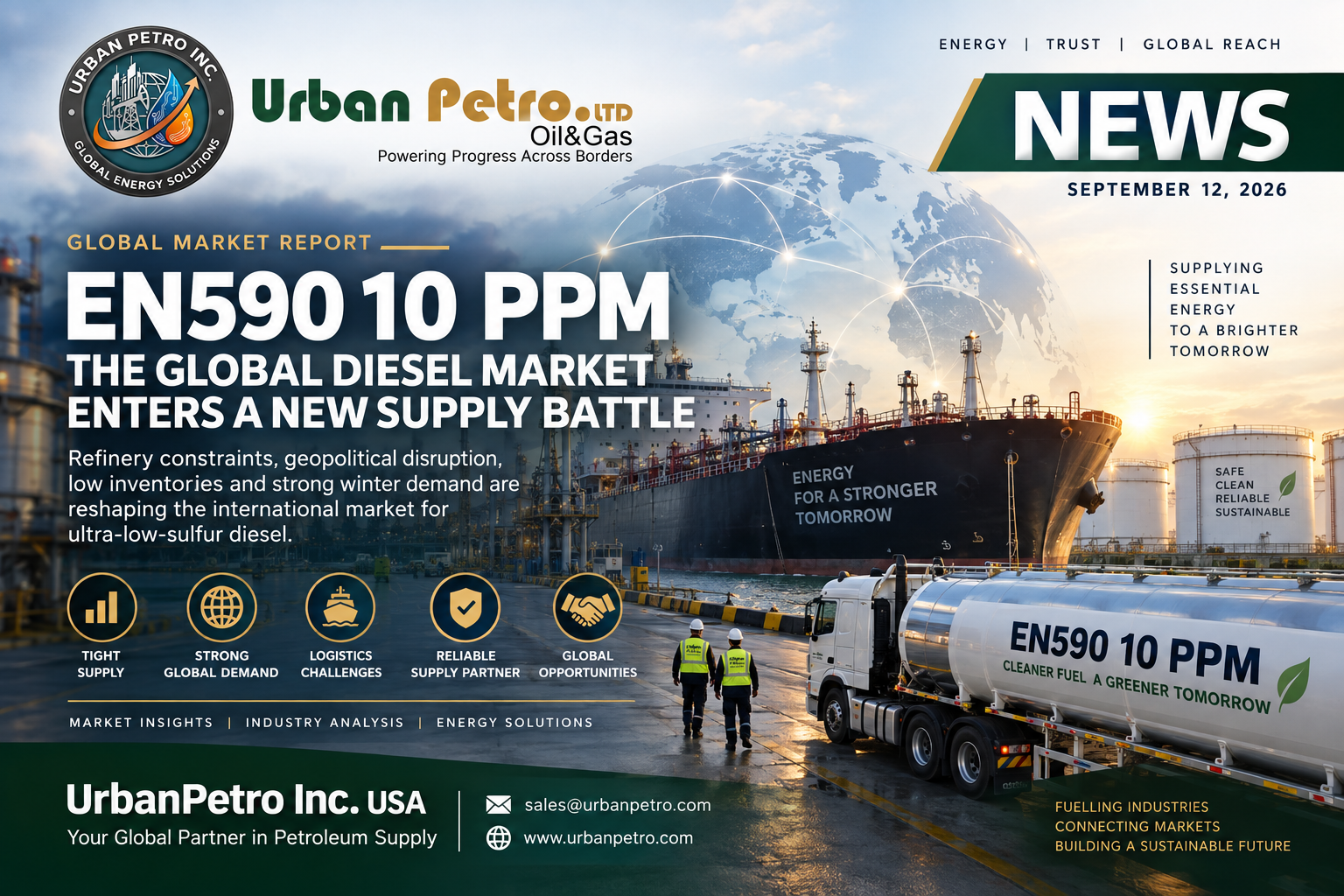
EN590 10 PPM: THE GLOBAL DIESEL MARKET ENTERS A NEW SUPPLY BATTLE
Refinery constraints, geopolitical disruption, low inventories and winter demand are reshaping the international market for ultra-low-sulfur diesel
UrbanPetro Global Energy News
September 12, 2026
THE DIESEL MARKET HAS ENTERED A NEW PHASE
The global petroleum market is entering one of the most challenging periods of 2026.
While crude oil continues to attract most of the headlines, the increasingly important story is developing further downstream:
Diesel.
The international market for middle distillates, including EN590 10 PPM diesel, is facing a combination of refinery constraints, disrupted trade routes, restricted exports, elevated freight costs, low inventories and approaching winter demand.
The result is a fundamental change in the way international buyers are approaching fuel procurement.
The question is no longer simply:
“What is the price of diesel?”
The more important question is:
“Where is the physical diesel, who controls the cargo, can it be verified, and can it actually be delivered?”
That distinction is becoming critical.
GLOBAL DIESEL SUPPLY IS UNDER PRESSURE
The International Energy Agency’s September 2026 Oil Market Report provides a clear indication of the scale of the current market disruption.
Global oil production fell by approximately 1.6 million barrels per day in August, while more than 10 million barrels per day of Gulf output remained shut in amid heightened security risks.
At the same time, global refinery throughput reached approximately 81.4 million barrels per day in August but remained significantly below the previous year’s level.
The IEA expects global refinery runs to decline by approximately 2.6 million barrels per day in 2026.
This is particularly important for diesel buyers because crude availability and refined-product availability are not the same thing.
Crude must be transported, processed and converted into the correct specification before it becomes a commercially deliverable diesel cargo.
EN590 10 PPM IS BECOMING A STRATEGIC PRODUCT
EN590 10 PPM diesel is ultra-low-sulfur diesel designed around a maximum sulfur content of approximately 10 ppm under the applicable EN590 specification.
Its importance extends far beyond passenger vehicles.
Diesel is essential to:
- Heavy transportation
- Mining
- Agriculture
- Construction
- Manufacturing
- Power generation
- Logistics
- Government fleets
- Marine and industrial applications
- Fuel distribution networks
As a result, disruption to diesel supply can quickly affect transportation costs, food distribution, construction activity and industrial production.
The current market therefore creates a premium for reliable physical supply, not simply paper offers.
EUROPE: DIESEL MARGINS REACH EXTREME LEVELS
Europe has become one of the clearest examples of the changing diesel market.
S&P Global reported that the Amsterdam-Rotterdam-Antwerp diesel crack reached approximately $98 per barrel on September 1, a record level, before easing somewhat.
Northwest European ULSD 10 ppm cargo was assessed by Platts at approximately $1,456.50 per metric ton on September 2, while Mediterranean ULSD 10 ppm cargo was assessed at approximately $1,452.75 per metric ton.
Those levels demonstrate how strongly the physical diesel market has responded to tightening supply conditions.
Europe is particularly exposed because it is structurally dependent on imported diesel.
The region has increasingly relied on alternative sources following changes in Russian product flows and disruptions affecting Middle Eastern supply.
At the same time, Europe is approaching the autumn and winter period when diesel and heating-related demand become increasingly important.
RUSSIA REMAINS A MAJOR FACTOR
Russian refined-product exports remain one of the most important variables in the international diesel market.
Russia’s diesel export restrictions have removed significant volumes from international trade.
Reuters reported that the continuing restrictions are contributing to a global diesel supply squeeze, while industry executives have warned that the market could remain tight through winter.
The consequence is not limited to Europe.
When traditional Russian buyers lose access to those barrels, they must compete for alternative supplies from:
- The United States
- India
- The Middle East
- China
- Other refining centers
This creates competition for the same physical cargoes.
THE UNITED STATES IS ALSO FEELING THE PRESSURE
The U.S. diesel market is becoming another important indicator.
The latest EIA outlook projects U.S. distillate inventories to fall below 100 million barrels in September and remain below the five-year 2021–2025 range through the end of 2026 and much of 2027.
That creates additional competition for available refined products.
The U.S. market therefore cannot simply be considered an unlimited emergency source of diesel for the rest of the world.
Domestic requirements, export demand, refinery maintenance and logistics all compete for available barrels.
ASIA: THE NEXT BATTLE FOR DIESEL SUPPLY
Asia is becoming increasingly important to the international diesel balance.
India in particular has become a strategically important refining and export center.
As Europe searches for replacement diesel supplies, Asian refiners can become increasingly important suppliers.
But there is a limitation.
Asian refineries must balance:
Domestic demand
against
Export economics
and
Strategic fuel security.
If export volumes increase, additional diesel can reach international markets.
If domestic requirements rise or export restrictions change, available export volumes can tighten rapidly.
China is another important variable.
Higher Chinese exports could provide relief to international buyers, but domestic supply requirements and government policy will determine how much product actually reaches international markets.
THE MIDDLE EAST AND THE STRAIT OF HORMUZ
The Middle East remains one of the biggest risks to the global petroleum supply chain.
The Strait of Hormuz is particularly important because the region supports not only crude oil exports but also refined petroleum products, LNG and petrochemical feedstocks.
Any reduction in tanker traffic can immediately affect:
- Freight rates
- Insurance costs
- Vessel availability
- Delivery schedules
- Regional product prices
- Buyer competition
The market is therefore increasingly pricing logistical risk, not simply commodity value.
The IEA reported that tanker traffic from the Middle East has been affected by renewed attacks and that oil-on-water volumes declined sharply in August.
THIS IS NOT SIMPLY A CRUDE-OIL SHORTAGE
One of the most important lessons from the current market is that:
CRUDE OIL AVAILABILITY DOES NOT EQUAL DIESEL AVAILABILITY.
A crude cargo sitting in the wrong location cannot immediately solve a shortage of EN590 diesel in another region.
The complete chain must function:
Crude → Refinery → EN590 Production → Storage → Inspection → Vessel → Port → Customs → Buyer
A problem at any point can reduce the availability of a deliverable cargo.
That is why serious international buyers are becoming more interested in the complete supply chain.
WHAT SERIOUS EN590 BUYERS SHOULD VERIFY
In today’s market, a professional buyer should not make a purchasing decision based solely on a price quotation, screenshot or commercial offer.
Before committing to a physical transaction, buyers should verify:
1. PRODUCT
- EN590 specification
- Sulfur content
- Density
- Cetane characteristics
- Flash point
- Distillation characteristics
- Other applicable quality parameters
2. SOURCE
- Refinery or legitimate supply source
- Origin
- Allocation
- Seller authority
- Export authorization where applicable
3. QUANTITY
- Available volume
- Trial quantity
- Monthly contractual quantity
- Loading schedule
- Port capacity
4. LOGISTICS
- Loading port
- Discharge port
- Vessel arrangements
- Freight
- Insurance
- Delivery schedule
- Incoterms
5. DOCUMENTATION
Depending on the transaction structure, buyers may need to verify appropriate documentation such as:
- Certificate of Quality
- Certificate of Quantity
- Independent inspection documentation
- Bill of Lading
- Commercial invoice
- Certificate of Origin
- Export documentation
- Vessel documentation
- Relevant contractual documents
The exact documentation depends on the transaction and jurisdiction.
URBANPETRO: CONNECTING BUYERS WITH THE PHYSICAL ENERGY MARKET
Against this increasingly complicated background, UrbanPetro Inc., USA continues to position its business around international petroleum supply, trading coordination and logistics.
UrbanPetro publicly identifies EN590 10 PPM diesel among its principal petroleum products and states that its business model covers international fuel trading, sourcing, logistics, storage and delivery coordination.
The company’s published supply framework includes CIF, FOB and TTO transaction structures, subject to individual transaction requirements.
UrbanPetro’s public website also identifies its principal corporate office in Miami, Florida, with business operations and contacts covering the United States, United Kingdom and Bolivia.
URBANPETRO’S GLOBAL SUPPLY APPROACH
The current market demonstrates why petroleum trading cannot be based only on finding a low headline price.
A competitive physical supply solution requires coordination between:
SUPPLIER
↓
REFINERY / STORAGE
↓
QUALITY CONTROL
↓
VESSEL / LOGISTICS
↓
PORT
↓
BUYER
UrbanPetro’s commercial approach is designed around this wider supply chain.
For qualified international buyers, the company can coordinate discussions concerning:
- EN590 10 PPM diesel
- International CIF supply
- FOB supply opportunities
- Physical fuel sourcing
- Logistics coordination
- Storage and terminal arrangements
- Documentation
- Inspection coordination
- International delivery
- Long-term supply discussions
Actual availability, quantity, origin, price, loading window and delivery terms must be confirmed for each transaction.
A NEW DEFINITION OF “AVAILABLE”
The word AVAILABLE is becoming one of the most abused words in the international petroleum market.
A product can appear available on paper but still be impossible to deliver because:
- The refinery has not allocated the volume.
- The cargo is already committed.
- The loading window has expired.
- The vessel is unavailable.
- Insurance cannot be obtained.
- Export authorization is unavailable.
- The product cannot be independently verified.
- The seller does not control the cargo.
- The logistics economics no longer work.
Therefore:
A PAPER BARREL IS NOT THE SAME AS A PHYSICAL BARREL.
The real test is execution.
URBANPETRO BUYER DESK
UrbanPetro is currently engaging with international buyers, distributors, industrial users, government-related procurement organizations and qualified mandates seeking EN590 10 PPM supply.
Interested parties should submit a professional company profile and formal Letter of Intent describing:
- Buyer company
- Country
- Required quantity
- Trial quantity
- Monthly requirement
- Target discharge port
- Preferred procedure
- Delivery requirement
- Contact person
- Corporate registration information
After preliminary review, UrbanPetro can determine whether the requirement is commercially suitable for further discussion.
IMPORTANT
Product availability, price, origin, quantity, loading schedule and delivery terms are transaction-specific and subject to confirmation and documentary verification.
This approach protects both buyer and seller.
WHY THE CURRENT MARKET CREATES AN OPPORTUNITY
The present market environment is difficult for buyers.
But difficult markets can create opportunities for companies capable of coordinating physical supply.
The strongest trading relationships will increasingly be built around:
VERIFIED SUPPLY
EXECUTION
LOGISTICS
DOCUMENTATION
COMPLIANCE
LONG-TERM RELATIONSHIPS
Price remains important.
But price without deliverability has little commercial value.
THE URBANPETRO MARKET VIEW
UrbanPetro’s market view is that the international EN590 10 PPM market will remain highly sensitive through the coming autumn and winter period.
Five factors deserve particular attention:
1. Russian refined-product exports
Further restrictions could reduce available international diesel volumes.
2. Middle Eastern supply
Any improvement or deterioration in regional shipping conditions could rapidly change physical availability.
3. European imports
Europe’s dependence on imported diesel makes it highly sensitive to global cargo competition.
4. Asian exports
India and China could become increasingly important sources of replacement diesel.
5. Winter demand
Seasonal demand could intensify competition for middle distillates.
These factors do not guarantee a shortage.
They do, however, create a market in which verified physical supply is increasingly valuable.
THE GLOBAL MESSAGE
The EN590 10 PPM market is not disappearing.
It is being reorganized.
Traditional trade routes are changing.
Refinery economics are changing.
Shipping risks are changing.
Buyer relationships are changing.
And the definition of supply is changing.
The companies that succeed in this environment will not necessarily be those advertising the lowest number.
They will be the companies capable of demonstrating:
WHERE THE PRODUCT IS
WHO CONTROLS IT
HOW IT WILL BE VERIFIED
HOW IT WILL BE LOADED
HOW IT WILL BE SHIPPED
AND HOW IT WILL REACH THE BUYER
That is the new reality of international diesel trading.
URBANPETRO — EN590 10 PPM GLOBAL SUPPLY
For qualified buyers seeking EN590 10 PPM diesel for international delivery, UrbanPetro Inc. welcomes serious commercial enquiries.
URBANPETRO INC. — USA
EN590 10 PPM | GLOBAL PETROLEUM SUPPLY | TRADING | LOGISTICS
Sales: sales@urbanpetro.com
General: info@urbanpetro.com
Website: www.urbanpetro.com
USA: +1 940 618 3751
Bolivia: +591 733 91550
Head Office:
111 NE 1st St, 8th Floor, Suite #89190
Miami, Florida 33132, USA
Join UrbanPetro Energy Community
Get global petroleum and energy market updates directly on WhatsApp.
✔ Global Energy News
✔ Petroleum Market Updates
✔ EN590 / Diesel Market Information
✔ Crude Oil News
✔ Refinery & Shipping Updates
✔ Industry Opportunities
✔ UrbanPetro Announcements
https://chat.whatsapp.com/Lgva0UkOsu5EythTalBKpkT
Scan to Join


EDITORIAL NOTE
This article is a market-analysis and industry-information feature. Market conditions, prices, supply, freight, geopolitical developments and refinery operations can change rapidly.
References to UrbanPetro’s product capabilities are based on information published by UrbanPetro. Specific product availability, quantity, origin, price, documentation and delivery terms must be confirmed independently for each transaction before any commercial commitment is made.
UrbanPetro does not represent that every quantity advertised or discussed in the international market is immediately available at all times.
Source basis: International Energy Agency, U.S. Energy Information Administration, S&P Global Energy, Reuters and other publicly reported industry information.