GLOBAL ENERGY SUPPLY SHOCK DEEPENS
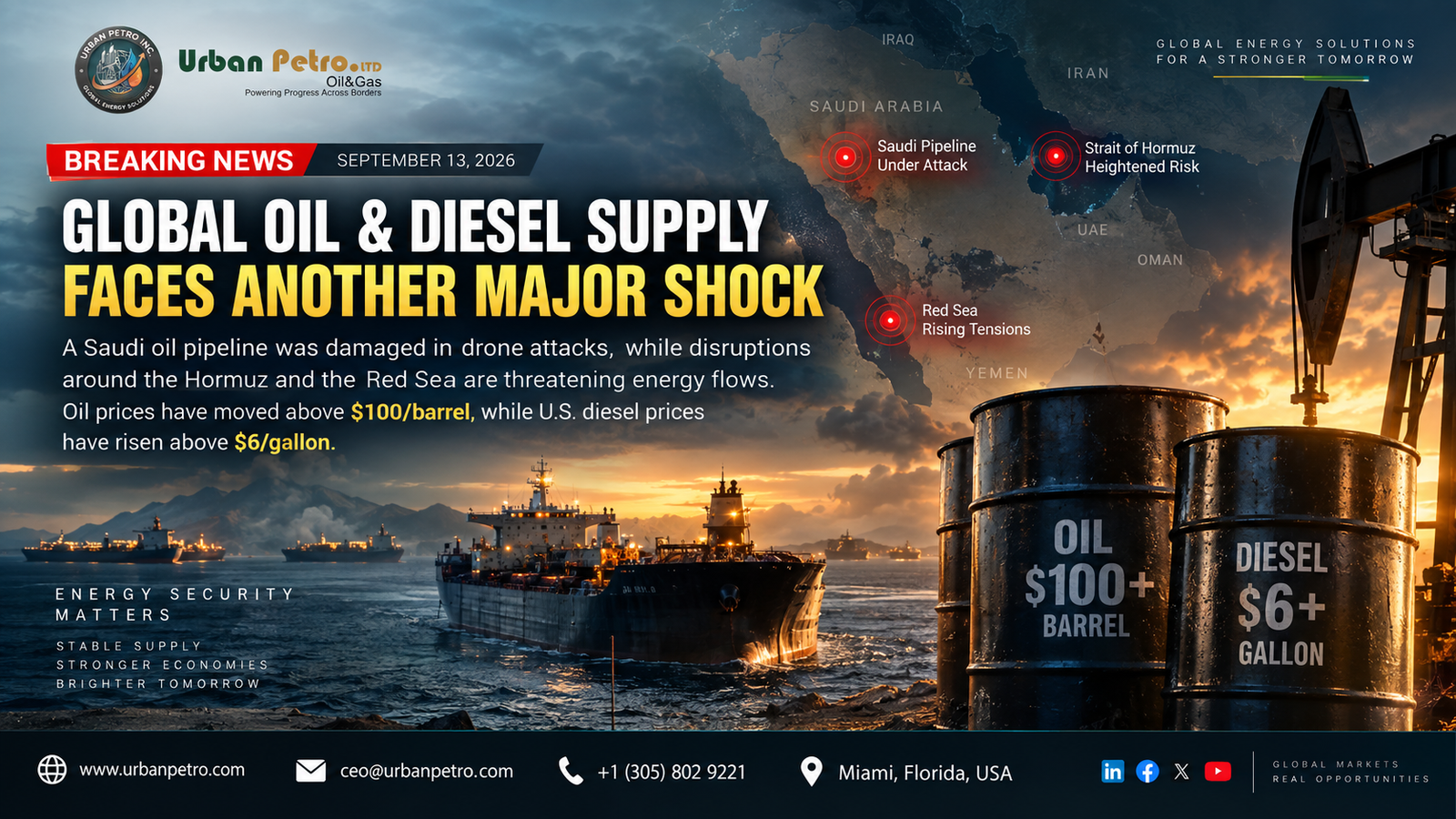
Saudi Pipeline Shutdown, Strait of Hormuz Risk and Red Sea Disruption Put Global Oil & Diesel Markets on High Alert
September 13, 2026 | Global Energy Market Special Report
By UrbanPetro Inc. USA — Global Energy Desk
Chief Editor: Mr. Baiju Jayachandran
Associate Editor: Mr. Ibrahim Khalil Ahram
THE WORLD’S ENERGY ROUTES ARE UNDER PRESSURE
The global petroleum market is entering a critical period as several major energy transportation routes face simultaneous disruption.
Saudi Arabia has temporarily shut its strategic East-West oil pipeline following attacks, removing an important alternative route for moving crude from the Kingdom’s eastern production areas to the Red Sea.
According to Reuters reporting published September 13, the pipeline has been handling approximately 4 million barrels per day, equivalent to around 4% of global oil supply. Industry sources cited by Reuters warned that continued disruption could place significant pressure on Saudi export availability if alternative stocks are depleted.
The development comes at an already sensitive moment for global energy markets, with shipping through the Strait of Hormuz severely disrupted and security risks increasing around the Red Sea and Bab el-Mandeb.
THREE ENERGY CHOKEPOINTS. ONE GLOBAL MARKET.
The significance of the current situation is not limited to one pipeline.
Global energy traders are watching three strategic corridors simultaneously:
1. STRAIT OF HORMUZ
A new report today indicated that a projectile struck a vessel transiting the Strait of Hormuz, adding another layer of uncertainty for tanker operators and energy traders.
The Strait is one of the world’s most important energy chokepoints. The International Energy Agency estimates that approximately 20 million barrels per day of oil passed through the Strait in 2025—around one-quarter of global seaborne oil trade.
2. SAUDI EAST-WEST PIPELINE
Saudi Arabia’s East-West pipeline has become particularly important because it provides a route that can bypass the Strait of Hormuz.
Its shutdown therefore removes part of the world’s limited ability to redirect Middle Eastern crude away from the Gulf.
Reuters reports that the pipeline had been moving around 4 million barrels per day, and that Saudi export stocks at Yanbu could become constrained within days if the pipeline cannot resume operations.
3. RED SEA & BAB EL-MANDEB
At the other end of the Arabian Peninsula, instability around Yemen and the Bab el-Mandeb is creating additional risks for shipping.
The Associated Press reports that fighting in Yemen has intensified and that Houthi forces have claimed attacks against Saudi Arabia, while the strategic Red Sea corridor remains under growing pressure.
For the international petroleum industry, this creates an extraordinary situation:
The alternative routes to Hormuz are themselves becoming increasingly vulnerable.
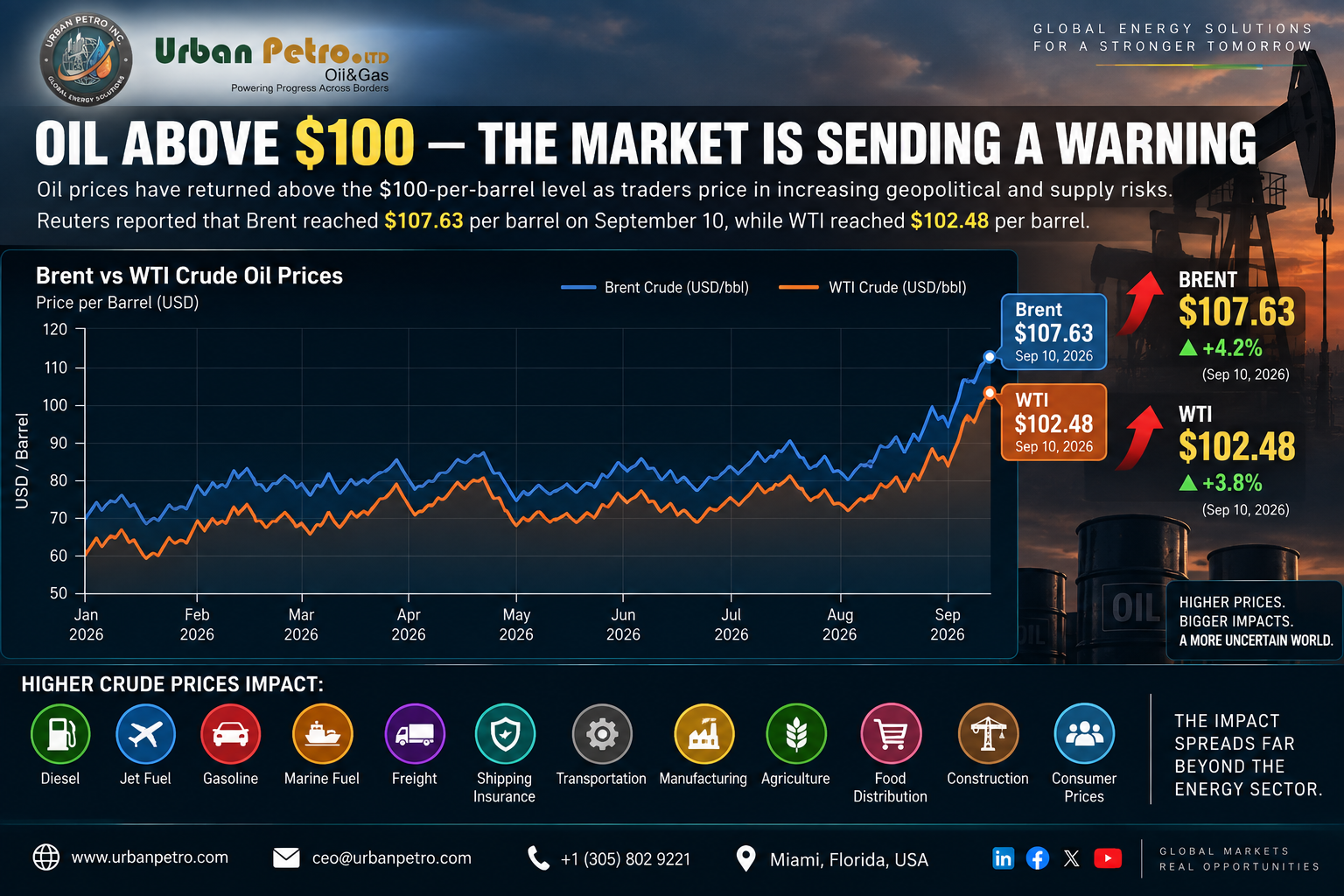
OIL ABOVE $100 — THE MARKET IS SENDING A WARNING
Oil prices have returned above the $100-per-barrel level as traders price in increasing geopolitical and supply risks.
Reuters reported that Brent reached $107.63 per barrel on September 10, while WTI reached $102.48 per barrel.
This is not simply a crude-oil story.
Higher crude prices can rapidly feed into:
- Diesel
- Jet fuel
- Gasoline
- Marine fuel
- Freight
- Shipping insurance
- Transportation
- Manufacturing
- Agriculture
- Food distribution
- Construction
- Consumer prices
The effect can therefore spread far beyond the energy sector.
DIESEL HAS BECOME THE CRITICAL MARKET
One of the most important developments for the global economy is the extraordinary rise in diesel prices.
According to Reuters, the U.S. national average diesel price exceeded $6 per gallon for the first time on September 10. U.S. diesel inventories were also reported to be approximately 13% below their five-year average.
Diesel is the fuel behind a huge portion of the physical economy.
Trucks move goods.
Ships move commodities.
Machines build infrastructure.
Agricultural equipment produces food.
Generators support industry.
Therefore, a prolonged diesel shortage can become an economic problem—not merely an energy-market problem.
WHY THIS MATTERS TO GLOBAL BUYERS
The current environment is creating a more complicated physical petroleum market.
Buyers are increasingly required to consider more than simply the nominal price of a barrel or metric ton.
They must evaluate:
Origin → Refinery → Loading Port → Vessel → Shipping Route → Insurance → Destination Port → Storage → Delivery
Any disruption along this chain can affect the final delivered cost.
For refined products such as EN 590 10 PPM Ultra-Low Sulfur Diesel, buyers should therefore pay particular attention to
🇺🇸 URBANPETRO INC. USA — WATCHING THE MARKET
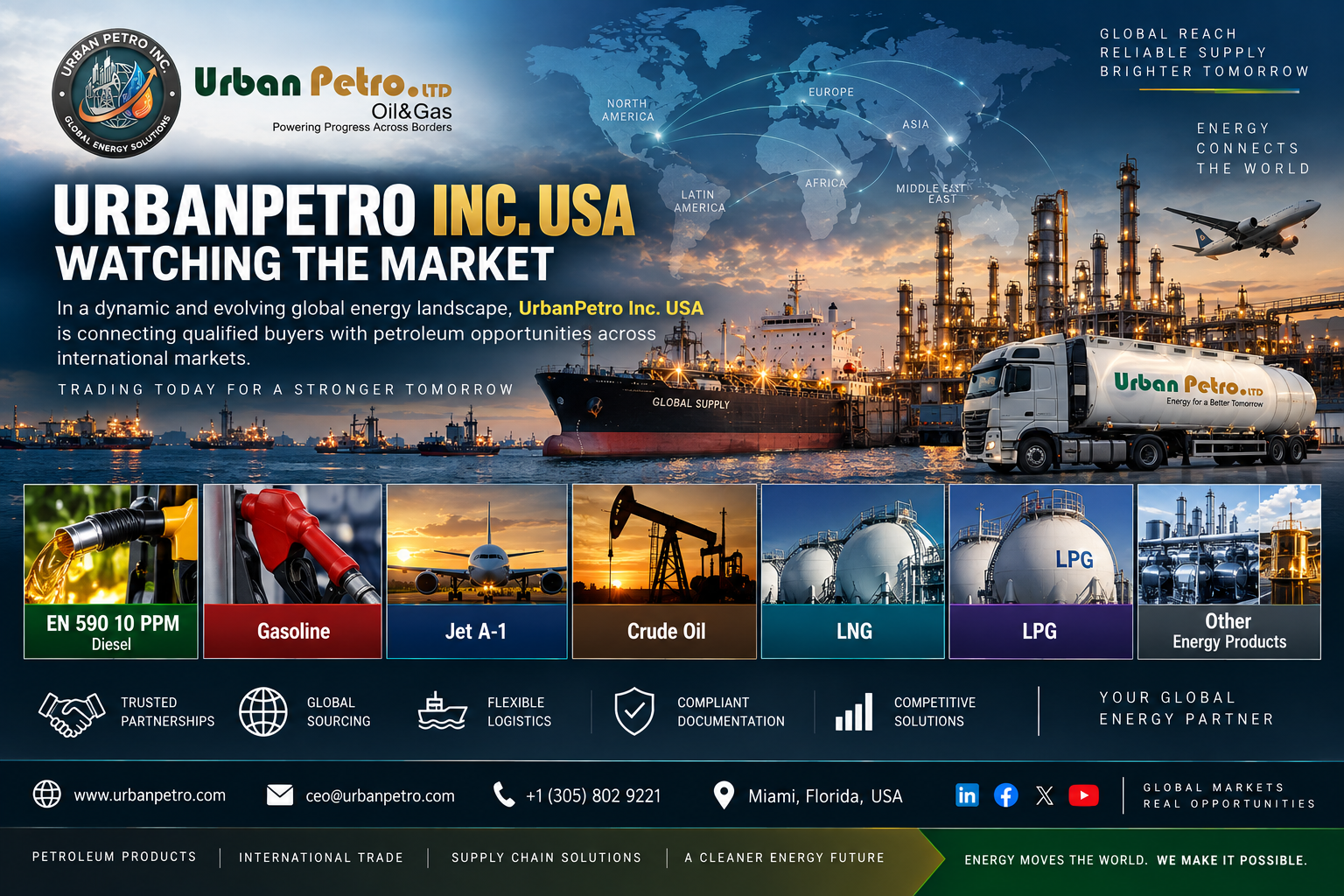
Against this increasingly volatile energy backdrop, UrbanPetro Inc. USA is positioning itself as an international petroleum trading and supply-market participant focused on connecting qualified buyers with petroleum opportunities across international markets.
UrbanPetro’s market focus includes petroleum products such as:
EN 590 10 PPM Diesel
Gasoline
Jet A-1
Crude Oil
LNG
LPG
Other Energy Products
The company works with international commercial counterparties and evaluates supply opportunities according to transaction requirements, destination, logistics, documentation and commercial terms.
UrbanPetro’s objective is simple:
CONNECT GLOBAL BUYERS WITH SERIOUS ENERGY SUPPLY OPPORTUNITIES.
⚠️ A NEW ERA OF ENERGY-SECURITY RISK
The current market demonstrates an important reality:
Energy security is no longer determined only by how much oil exists underground.
It is also determined by whether that oil can safely move:
from producer → to refinery → to port → onto a vessel → through a maritime chokepoint → to the buyer.
When several transportation corridors become vulnerable simultaneously, the physical supply chain becomes significantly more fragile.
The International Energy Agency has previously warned that disruption of the Strait of Hormuz could have major consequences for global oil markets because alternative export capacity is limited.
Today’s Saudi pipeline outage adds another layer to that vulnerability.
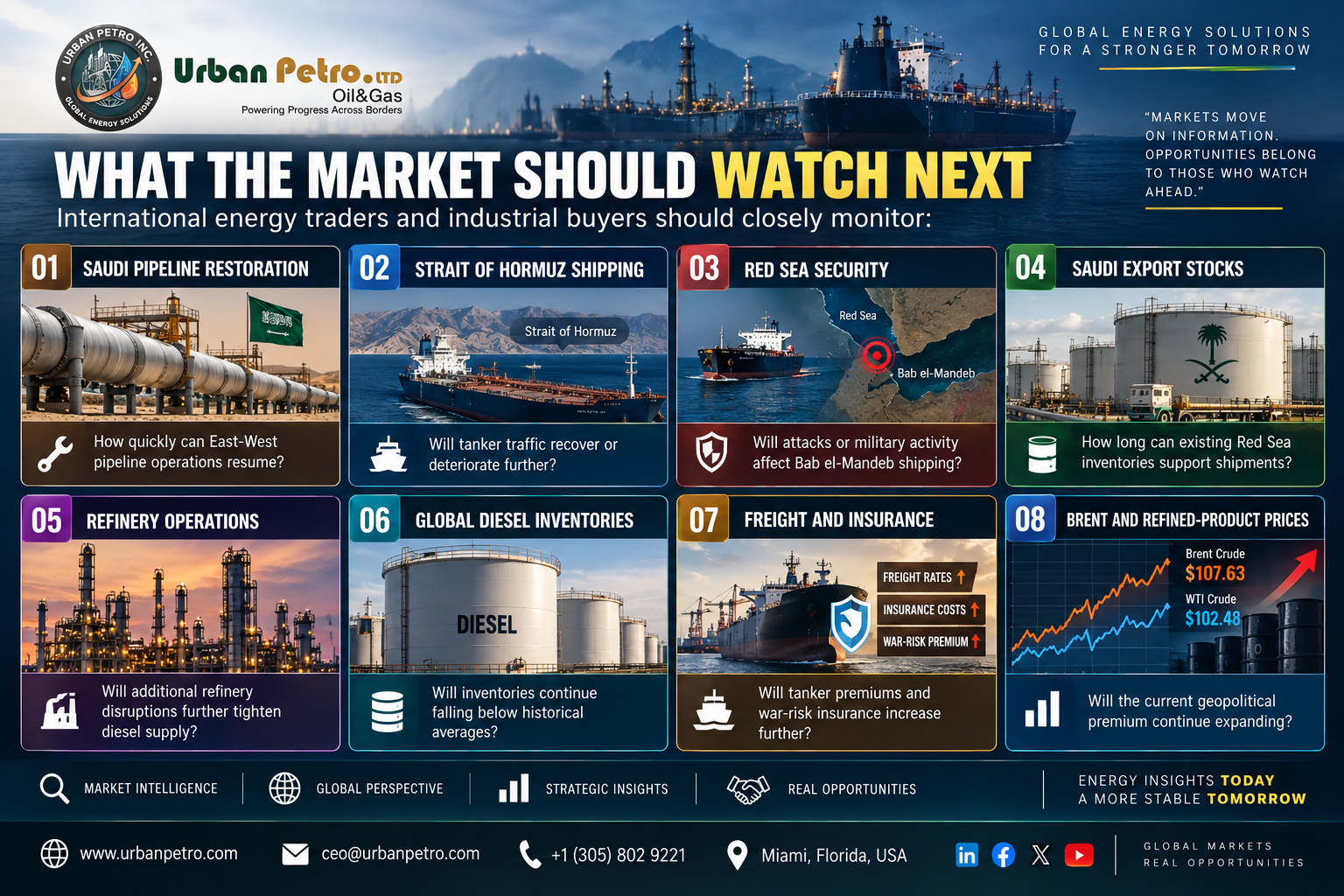
📈 WHAT THE MARKET SHOULD WATCH NEXT
International energy traders and industrial buyers should closely monitor:
01 — Saudi pipeline restoration
How quickly can East-West pipeline operations resume?
02 — Strait of Hormuz shipping
Will tanker traffic recover or deteriorate further?
03 — Red Sea security
Will attacks or military activity affect Bab el-Mandeb shipping?
04 — Saudi export stocks
How long can existing Red Sea inventories support shipments?
05 — Refinery operations
Will additional refinery disruptions further tighten diesel supply?
06 — Global diesel inventories
Will inventories continue falling below historical averages?
07 — Freight and insurance
Will tanker premiums and war-risk insurance increase further?
08 — Brent and refined-product prices
Will the current geopolitical premium continue expanding?
🔥 THE BIGGER QUESTION
The biggest question facing the petroleum market is no longer simply:
“How high can oil prices go?”
The more important question is:
“How much physical petroleum can the global supply chain safely move?”
That distinction could become critical for governments, refineries, airlines, shipping companies, logistics operators, manufacturers and fuel buyers worldwide.
🌐 URBANPETRO GLOBAL ENERGY ALERT
The global energy market is entering a period in which security, availability, logistics and verification may become just as important as price.
UrbanPetro Inc. USA will continue monitoring international petroleum markets, supply developments, transportation risks and refined-product availability.
For qualified commercial buyers seeking petroleum supply opportunities, UrbanPetro encourages early engagement, proper due diligence and complete documentary verification before entering any transaction.
GLOBAL ENERGY. GLOBAL CONNECTIONS. PROFESSIONAL SUPPLY.
URBANPETRO INC. USA
Chief Editor:
Mr. Baiju Jayachandran
Associate Editor:
Mr. Ibrahim Khalil Ahram
Published: September 13, 2026
