
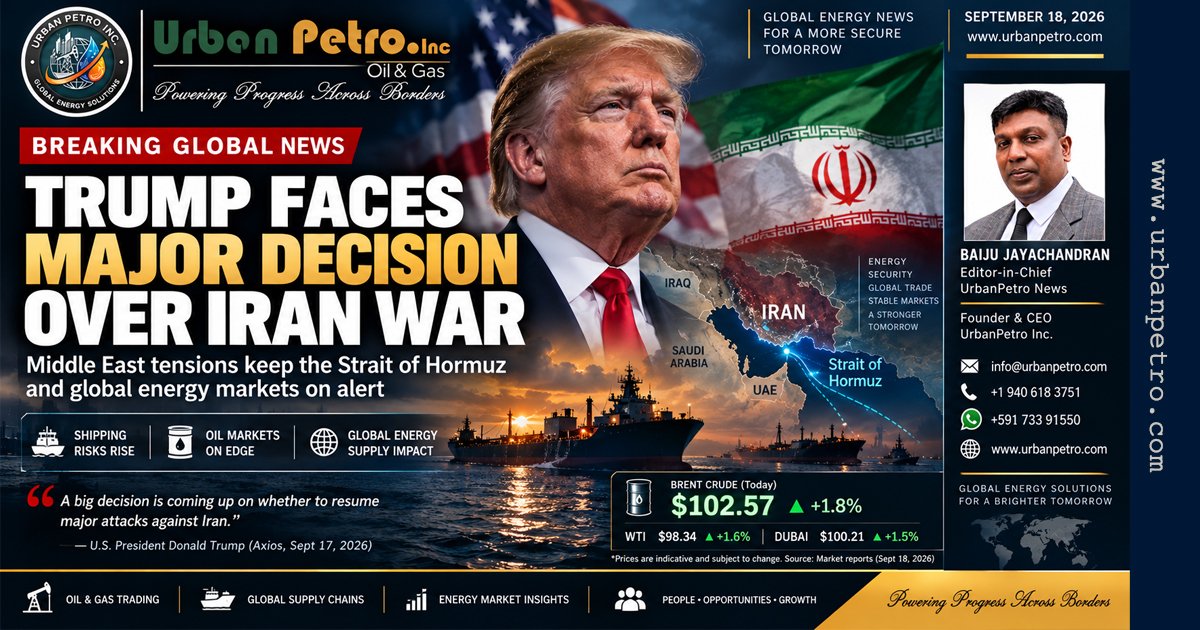
UrbanPetro Global News | September 18, 2026
By Baiju Jayachandran, Editor-in-Chief, UrbanPetro News
WASHINGTON —
The Iran conflict has entered another critical phase after U.S. President Donald Trump said he is approaching a major decision over whether to resume large-scale military operations against Iran.
In an interview with Axios on Thursday, Trump said he had a “big decision coming up” and was considering whether to launch renewed major attacks against Iran. His remarks come as the conflict continues to affect regional security, shipping routes and global energy markets.
The comments have placed renewed attention on the possibility of further military escalation at a time when governments and energy markets are already closely watching developments around the Strait of Hormuz, one of the world’s most strategically important oil-shipping corridors.
Gulf leaders prepare for talks with Trump
Trump is expected to meet leaders from Saudi Arabia, the United Arab Emirates, Qatar, Bahrain, Kuwait and Oman on the sidelines of the United Nations General Assembly in New York.
According to reporting on the interview, Trump said he wants to hear directly from Gulf leaders about the regional situation before determining the next phase of U.S. policy.
The meeting could become an important diplomatic moment as Washington weighs military, economic and diplomatic options.
Strait of Hormuz remains a major energy-market concern
The conflict has increasingly become an energy-security story as well as a geopolitical crisis.
The Strait of Hormuz is a critical route for international oil and gas shipments, meaning any prolonged disruption or uncertainty surrounding vessel movements can influence crude prices, freight costs, insurance premiums and refinery supply chains.
Recent reports indicate that tensions around the waterway remain high. Iran has also claimed that it struck an oil tanker attempting to transit the Strait.
Meanwhile, Reuters reports that continuing instability involving Iran and Houthi forces in Yemen is creating additional pressure on important Middle Eastern shipping routes and contributing to concerns over global energy supplies.
Oil markets remain highly sensitive to development
Energy traders continue to assess how the conflict could affect crude oil availability, shipping and refinery feedstock.
Reports on Friday indicated that Brent crude was trading around the $103–$104 per barrel range as markets reassessed Middle East supply risks. Oil prices can move rapidly as new military, diplomatic or shipping developments emerge.
For petroleum buyers, refiners, shipping companies and commodity traders, the situation creates additional uncertainty around:
- Crude oil supply availability
- Diesel and refined-product pricing
- Tanker freight and insurance
- Strait of Hormuz transit conditions
- Middle East refinery operations
- European and Asian energy procurement
- Global petroleum supply chains
Diplomacy remains in the picture
Despite Trump’s comments about a possible return to major military action, diplomatic contacts have not completely disappeared.
Trump has previously indicated that Iran has expressed interest in reaching an agreement, while Iranian officials have continued to set conditions for negotiations. The conflicting positions leave the next stage of the conflict uncertain.
The upcoming UN General Assembly therefore takes place against the backdrop of an unresolved conflict, regional security concerns and heightened pressure on international energy markets.
What the energy industry is watching
For the global petroleum sector, the immediate focus is not only whether military operations expand, but whether the conflict produces sustained disruption to crude oil and refined-product transportation.
Any significant deterioration around the Strait of Hormuz or other regional shipping corridors could affect supply schedules, freight markets and delivered petroleum prices across Asia, Europe, Africa and other importing regions.
UrbanPetro News will continue tracking developments affecting crude oil, EN590 diesel, Jet A-1, refined petroleum products, shipping and international energy markets as new information becomes available.
UrbanPetro Market Watch
Key developments to monitor:
🇺🇸 U.S. policy: Trump faces a major decision regarding the next phase of military action against Iran.
🇮🇷 Iran: Tehran remains central to the regional security and energy-supply situation.
🚢 Strait of Hormuz: Vessel movements and shipping security remain critical indicators for petroleum markets.
🛢️ Oil markets: Brent crude remains highly sensitive to developments in the Middle East.
🌍 Global energy trade: Refiners, traders and buyers are monitoring potential effects on supply, freight and delivery schedules.
🇺🇳 United Nations: The upcoming General Assembly provides a major diplomatic platform for discussions surrounding the conflict.
Editorial Note
UrbanPetro News is an independent energy and international-business news platform focused on petroleum markets, commodities, global trade and geopolitical developments affecting the energy sector.
Editor-in-Chief: Baiju Jayachandran
Publication: UrbanPetro News
Website: UrbanPetro.com
This report is based on publicly available reporting and statements available as of September 18, 2026. Military and diplomatic developments remain fluid, and information may change as events develop.