
Global Energy Markets Face Renewed Middle East Supply Risk
UrbanPetro Global Energy News
Chief Editor: Mr. Baiju Jayachandran
Date: September 25, 2026
Middle East tensions keep oil markets highly volatile
The immediate focus for global petroleum and energy markets remains the evolving situation surrounding the Strait of Hormuz, Iran, Saudi Arabia and regional security.
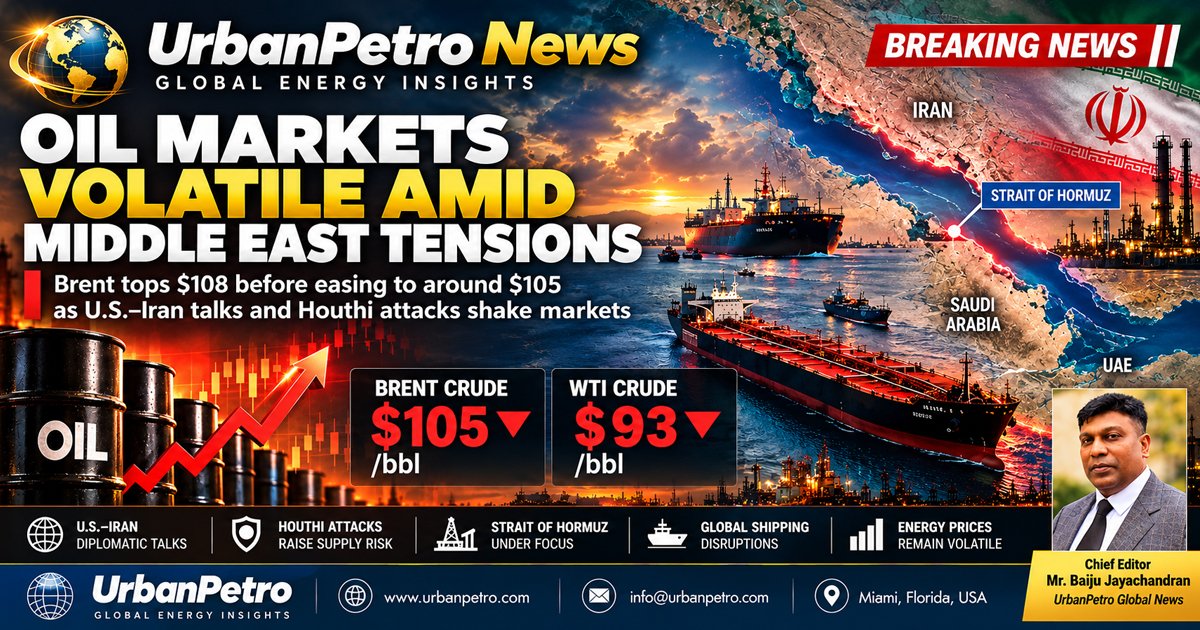
Oil prices have experienced sharp swings this week. On Thursday, Brent crude climbed to nearly $108 per barrel, before retreating as markets assessed reports of possible U.S.–Iran diplomatic progress and a potential phased reopening of the Strait of Hormuz.
As of Friday, September 25, Brent was trading around $105 per barrel, while WTI was near $93 per barrel, with prices moving lower as traders considered the possibility of a U.S.–Iran truce. At the same time, renewed Houthi attacks against Saudi Arabia continued to raise concerns about potential disruptions to regional energy infrastructure and exports.
Hormuz remains the key market variable
The Strait of Hormuz remains one of the most important factors influencing international crude oil and LNG flows. Recent shipping data indicated a substantial reduction in commercial vessel movements through the waterway compared with normal pre-conflict levels.
At the same time, Saudi Arabia has been working to maintain export flexibility through its East-West pipeline, which provides an alternative route toward the Red Sea and Yanbu. Reuters reported that the pipeline has restarted following an earlier attack, although restoration toward full capacity is expected to take time.
Supply security and freight costs under pressure
The disruption to traditional shipping routes is also affecting the physical oil market. Reuters reported on September 25 that ship-to-ship transfers in the Gulf of Oman had reached capacity limits as Middle Eastern producers and exporters adjusted their logistics around the Strait of Hormuz.
This environment is contributing to higher transportation complexity, changing crude flows and increased sensitivity to geopolitical developments.
What energy markets are watching
For the petroleum sector, several developments remain particularly important:
- U.S.–Iran diplomatic negotiations and any agreement affecting the Strait of Hormuz.
- Security around Saudi Arabian oil infrastructure and export facilities.
- The volume of crude and LNG moving through the Strait of Hormuz.
- Saudi Arabia’s alternative export routes through Yanbu and the East-West pipeline.
- Tanker availability, freight rates and ship-to-ship transfer capacity.
- Potential changes to U.S. diesel export policy and their effect on regional refined-product markets.
- Physical availability and pricing of crude oil, diesel, jet fuel and other refined products.
UrbanPetro Energy Market View
The current market remains highly sensitive to both geopolitical developments and physical supply movements. Thursday’s move toward $108 per barrel demonstrated how quickly prices can respond to renewed supply concerns, while Friday’s retreat toward the $105 area showed the equally strong influence of diplomatic expectations.
For international buyers, sellers, refiners, traders and logistics companies, the current environment reinforces the importance of monitoring real-time pricing, cargo availability, shipping routes, insurance, freight costs and delivery schedules rather than relying solely on headline benchmark prices.
UrbanPetro Global Energy News will continue monitoring developments across the Middle East, global crude markets, refined petroleum products, shipping routes and energy supply chains.

Chief Editor:
Mr. Baiju Jayachandran
UrbanPetro Global Energy News