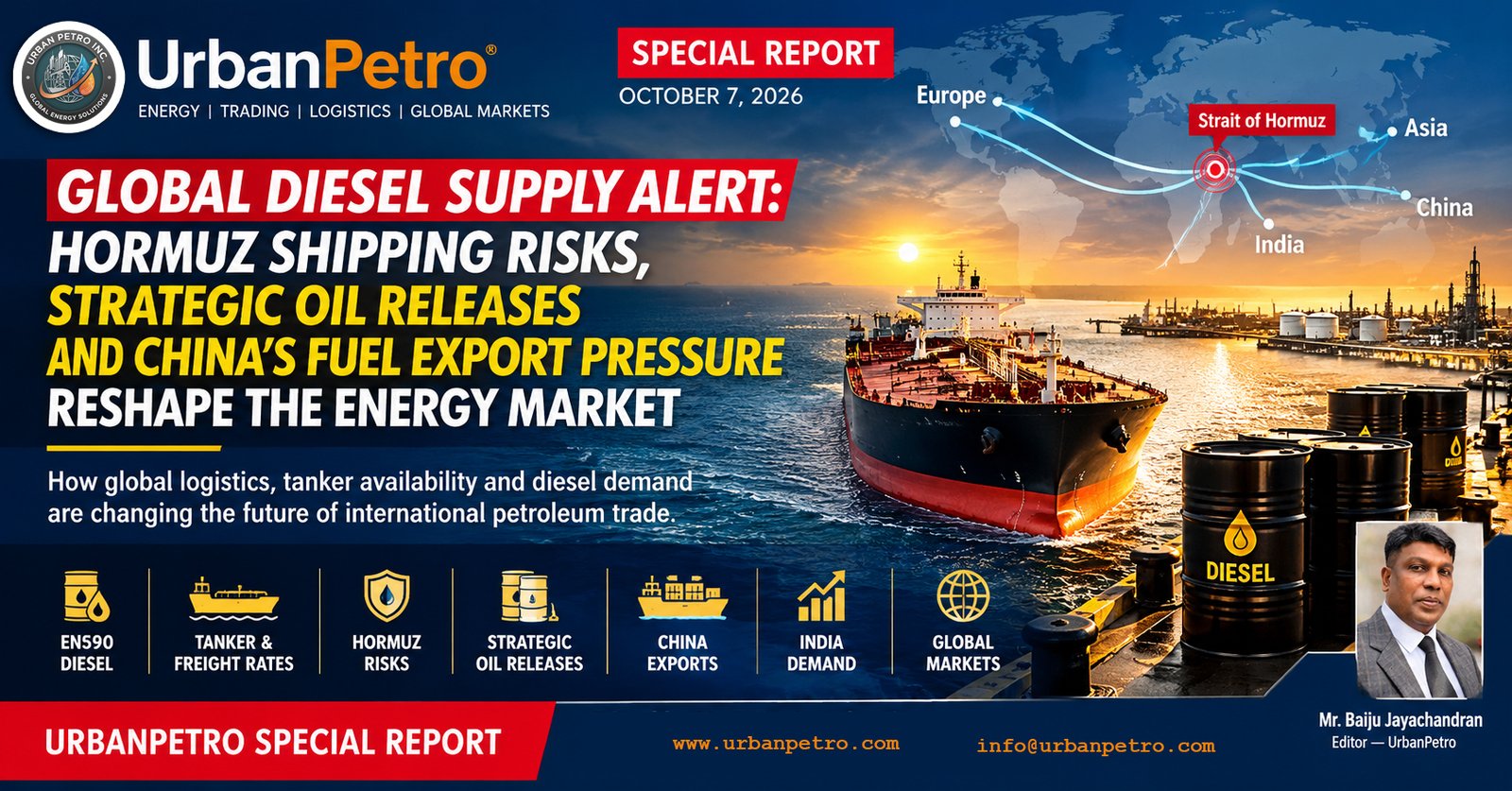
GLOBAL DIESEL SUPPLY ALERT: Hormuz Shipping Risks, Strategic Oil Releases and China’s Fuel Export Pressure Reshape the Energy Market
UrbanPetro Special Report
October 7, 2026
by Mr. Baiju Jayachandran
— UrbanPetro
The Global Energy Market Is Entering a New Phase
The international petroleum market is facing a rapidly changing environment in which the biggest challenge is no longer simply the availability of crude oil.
The growing problem is logistics, refined-product availability, tanker security, freight costs, insurance and the ability to move diesel from producing regions to consuming markets.
New developments reported on October 7, 2026, show that the pressure on global diesel markets remains severe. The International Energy Agency has supported accelerating the release of previously committed emergency oil stocks and prioritising diesel stocks because of tightness in diesel markets.
Approximately 325 million barrels have already been released under the March 2026 collective action, while around 100 million barrels of previously pledged stocks remain to reach the market.
The developments underline an increasingly important reality for petroleum traders, refiners, importers and industrial consumers:
Physical energy logistics have become as important as the commodity itself.
HORMUZ: THE WORLD’S MOST IMPORTANT ENERGY CHOKEPOINT REMAINS UNDER PRESSURE
The Strait of Hormuz continues to dominate the global petroleum market.
According to maritime-security data reported on October 7, tanker attacks, attempted attacks and harassment incidents during the week of September 28 to October 5 reached the highest weekly level since the Iran war began.
At least 12 incidents involving oil, LNG and LPG tankers were identified by maritime-security sources during that period.
The consequences extend far beyond the vessels directly affected.
When tanker operators face greater security risks, the market can experience:
Higher freight rates
Higher war-risk insurance
Longer voyage times
Reduced tanker availability
Greater difficulty securing vessels
Higher delivered fuel costs
Greater uncertainty for long-term supply contracts
This means that even when crude production or exports recover, the final delivered cost of petroleum products can remain elevated.
THE NEW PETROLEUM PROBLEM: LOGISTICS
Recent market developments demonstrate a significant transformation.
Oil flows from the Middle East have recovered substantially compared with the worst period of disruption, yet crude prices remain elevated and refined-product markets remain under pressure.
Why?
Because petroleum must travel through a complicated international infrastructure consisting of:
Production → Pipelines → Ports → Tank Storage → Tankers → Refineries → Product Terminals → Distributors → End Users
A disruption at any one of these stages can affect the final price and availability of fuel.
Shipping capacity is particularly important.
Recent market reporting indicates that tanker transportation costs from the Middle East to Asia have risen dramatically, demonstrating that the cost of transporting petroleum can become a major component of the delivered price.
For international buyers, therefore, the question is increasingly not simply:
“What is the price per metric ton?”
The more important question is:
“Can the product be delivered safely, consistently and economically to the required destination?”
DIESEL BECOMES THE CRITICAL PRODUCT
Diesel is emerging as one of the most strategically important petroleum products in the current market.
The IEA has specifically highlighted the tightness of diesel markets and supported prioritising diesel in the emergency stock-release programme.
Diesel is essential to:
Road transportation
Heavy trucks
Mining
Agriculture
Construction
Industrial machinery
Power generation
Marine transportation
Emergency services
Global supply chains
A shortage of diesel therefore has consequences far beyond the petroleum industry.
It can increase transportation costs, raise food-production expenses, increase industrial operating costs and contribute to broader inflation.
CHINA’S FUEL EXPORTS ADD ANOTHER LAYER OF PRESSURE
China’s reported suspension of some October oil-product exports has also attracted attention from international energy markets.
China is an important participant in Asian refined-product supply.
Any reduction in Chinese exports can tighten regional availability of:
Diesel + Gasoline + Jet Fuel
This is particularly significant when the Asian market is simultaneously dealing with shipping disruption, higher freight costs and geopolitical uncertainty.
For buyers in Asia, Africa, the Middle East and other import-dependent markets, alternative sources of reliable refined petroleum products could therefore become increasingly valuable.
INDIA: A KEY MARKET TO WATCH
India remains one of the world’s most important petroleum-consuming markets.
Growing diesel demand, industrial activity, transportation requirements and infrastructure development make India particularly sensitive to disruptions in global refined-product supply.
India also occupies a strategically important position between Middle Eastern petroleum producers and Asian consuming markets.
This makes Indian ports, storage terminals, refineries, shipping routes and petroleum trading companies increasingly important in the evolving global energy network.
For international suppliers and buyers, the Indian market will remain one of the most important indicators of Asian petroleum demand.
WHAT THIS MEANS FOR EN590 DIESEL
The current market environment is particularly relevant to EN 590 10 ppm diesel.
Buyers looking for large-volume diesel supply should increasingly evaluate more than the headline product price.
A serious international transaction should consider:
1. Product specification
Sulphur content, cetane number, density, flash point, viscosity and other contractual specifications.
2. Origin
The credibility and traceability of the product origin.
3. Refinery or supplier verification
Confirmation that the seller can actually perform the proposed supply.
4. Logistics
Availability of vessels, terminal capacity, storage and transportation routes.
5. Destination-port capability
Whether the receiving port can safely handle the proposed volume.
6. Payment structure
The buyer and seller should establish commercially acceptable banking and documentary procedures.
7. Inspection and quality control
Independent inspection and verification should be incorporated where appropriate.
8. Sanctions and regulatory compliance
International petroleum transactions require careful compliance screening and appropriate documentation.
THE STRATEGIC IMPORTANCE OF PETROLEUM TRADING COMPANIES
The current crisis highlights why international petroleum trading companies can play an increasingly important role in connecting supply with demand.
The modern petroleum trader is not simply buying and selling molecules.
A successful transaction can require coordination between:
Refineries + Producers + Traders + Banks + Inspectors + Shipping Companies + Ports + Tank Storage + Governments + End Users
This is where companies with international trading, logistics and market-development capabilities can potentially create value.
URBANPETRO: FOCUSING ON SUPPLY, MARKETS AND ENERGY LOGISTICS
For UrbanPetro Inc., USA, the changing global energy environment reinforces the importance of developing reliable relationships across petroleum supply chains.
UrbanPetro’s market focus includes international petroleum products, crude oil and energy-related trading and logistics opportunities.
The company sees the current environment as a reminder that successful petroleum trading requires more than identifying a competitive price.
It requires understanding:
Supply.
Demand.
Logistics.
Storage.
Shipping.
Documentation.
Compliance.
Risk.
And the final destination market.
As global petroleum markets become more interconnected and more exposed to geopolitical and logistical disruption, the ability to coordinate these elements becomes increasingly important.
THE NEXT PHASE OF THE ENERGY MARKET
The October 2026 market environment suggests that the global petroleum industry may be entering a new phase.
The traditional question was:
“Is there enough oil?”
The emerging question is:
“Can the right petroleum product reach the right market at the right time and at a commercially viable cost?”
That distinction could shape the international energy market for months to come.
Strategic petroleum reserves can release additional barrels.
Producers can increase exports.
Refineries can adjust operations.
Governments can introduce emergency measures.
But none of these solutions completely eliminates the need for secure transportation, adequate tanker capacity, functioning ports, storage infrastructure and reliable international trade routes.
URBANPETRO OUTLOOK
UrbanPetro believes the global petroleum market will increasingly reward companies that understand the complete supply chain rather than focusing on commodity pricing alone.
The future of international petroleum trading will increasingly depend on the integration of:
Energy Supply + Petroleum Trading + Maritime Logistics + Storage + Market Intelligence + Risk Management
For buyers seeking EN590 10 ppm diesel, crude oil and other petroleum products, the current market reinforces the importance of working through transparent, properly documented and commercially verifiable supply channels.
The energy market is changing.
And in this new environment, logistics is becoming energy security.
EDITORIAL NOTE
Mr. Baiju Jayachandran
Editor — UrbanPetro
UrbanPetro Special Reports are prepared to provide market-oriented analysis of developments affecting the international petroleum, energy and logistics sectors.
This report is for informational and market-analysis purposes. Commercial transactions should be subject to independent due diligence, contractual verification, applicable sanctions screening and relevant regulatory requirements.