
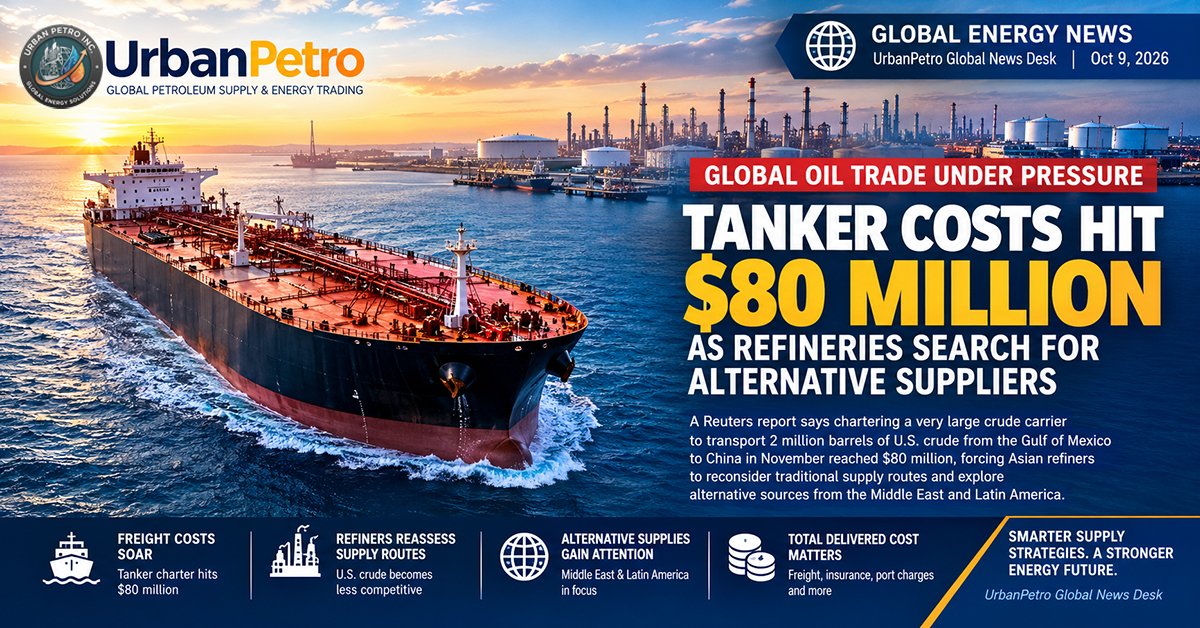
GLOBAL OIL TRADE UNDER PRESSURE: TANKER COSTS HIT RECORD LEVELS AS REFINERIES SEARCH FOR ALTERNATIVE SUPPLIERS
UrbanPetro Global News Desk | October 9, 2026
SINGAPORE / GLOBAL ENERGY MARKETS — Global crude oil trading is facing a growing logistical challenge as soaring tanker freight rates increase the cost of moving petroleum across international markets, forcing refiners and commodity traders to reconsider traditional supply routes.
In a development highlighting the growing importance of shipping economics in global energy trade, the cost of chartering a very large crude carrier to transport approximately 2 million barrels of U.S. crude oil from the Gulf of Mexico to China in November reached $80 million this week, according to a Reuters report published on October 9.
The report indicates that freight costs have become so high that the economics of transporting U.S. crude to Asia are no longer commercially viable for some market participants.
The situation could accelerate changes in international crude procurement strategies, with Asian refiners considering alternative grades from the Middle East and Latin America.
SHIPPING COSTS ARE REDEFINING THE GLOBAL OIL MARKET
For international petroleum traders, the cost of crude oil is only one component of a transaction. Freight, insurance, port charges, delivery schedules, financing and geopolitical risks can significantly influence the final delivered price.
When transportation costs rise sharply, a crude grade that appears competitive at the loading terminal may become substantially more expensive by the time it reaches the refinery.
This creates a difficult calculation for buyers: whether to maintain established supply arrangements or seek alternative origins that offer more competitive delivered costs.
The latest freight-market developments demonstrate why reliable logistics and carefully structured supply contracts are becoming increasingly important in international petroleum trading.
ASIAN REFINERIES MAY RECONSIDER THEIR SUPPLY SOURCES
According to Reuters, Asian refiners are considering alternatives to U.S. crude, including Murban crude from the United Arab Emirates and supplies from Latin America.
Any sustained shift in procurement decisions could influence regional crude differentials, tanker demand and the competitiveness of different export routes.
However, the extent of any change will depend on freight rates, crude quality, refinery requirements, available export volumes and the security of individual shipping routes.
For Latin American petroleum markets, the development is particularly relevant because transportation costs can affect the competitiveness of regional crude against supplies arriving from more distant producers.
It does not guarantee increased demand for Latin American oil, but it reinforces the importance of evaluating alternative supply origins when international freight markets become unusually expensive.
CRUDE OIL BUYERS MUST LOOK BEYOND THE HEADLINE PRICE
The current market highlights a critical principle for petroleum procurement: the lowest quoted crude price does not necessarily represent the lowest delivered cost.
Professional buyers must evaluate the complete commercial structure, including:
Crude quality and refinery compatibility.
Loading-terminal availability and export capacity.
Tanker freight and marine insurance.
Destination-port requirements.
Delivery schedules and operational risks.
Payment security and counterparty verification.
Total delivered cost under the proposed contract.
These considerations are particularly important for large-volume transactions, where changes in freight rates can materially affect the economics of an entire shipment.
WHAT THIS MEANS FOR INTERNATIONAL ENERGY TRADING
The latest developments reinforce the importance of flexible sourcing strategies, dependable shipping arrangements and transparent commercial procedures.
For suppliers and buyers alike, the ability to assess alternative origins and calculate realistic delivered costs may become a more significant competitive advantage as global transportation markets remain under pressure.
The central question for the oil industry is no longer simply where crude is cheapest. It is whether that crude can be delivered reliably, safely and competitively to the intended destination.
As global energy trade adjusts to changing freight economics and geopolitical uncertainty, shipping costs are becoming a decisive factor in petroleum procurement decisions.
UrbanPetro Global News Desk
Reporting focus: International crude oil markets, petroleum logistics, tanker freight and global energy supply.