OPEC+ Holds November Oil Output Steady as Global Energy Markets Remain Under Pressure
October 4, 2026 | UrbanPetro News | Global Energy Markets
OPEC+ keeps production targets unchanged as Brent remains above $100 per barrel
LONDON — Global oil markets remain under significant pressure after OPEC+ decided on October 4 to maintain its current production targets for November, while geopolitical disruptions continue to constrain physical energy supplies.
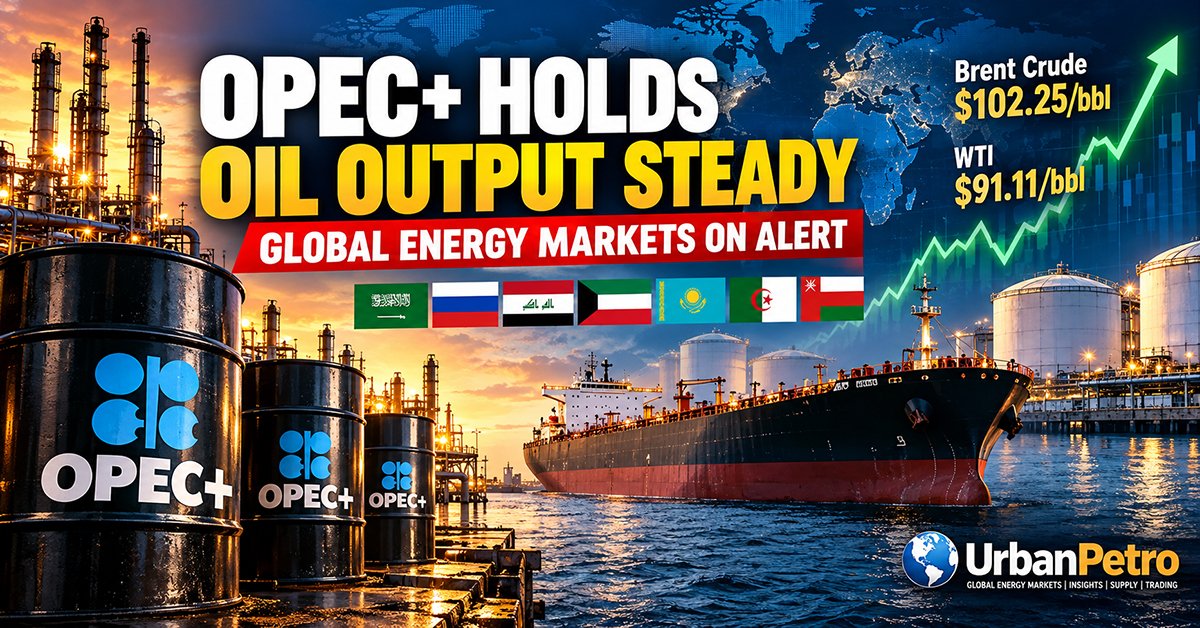
The decision was taken by seven key OPEC+ producers — Saudi Arabia, Russia, Iraq, Kuwait, Kazakhstan, Algeria and Oman — during a virtual meeting. The group confirmed that November production will remain at the required September 2026 level. OPEC said the participating countries will continue meeting monthly to assess market conditions, with the next meeting scheduled for November 1, 2026.
The decision comes at a critical moment for the international petroleum market. Brent crude recently settled around $102.25 per barrel, while U.S. West Texas Intermediate (WTI) settled around $91.11 per barrel.
Global Supply Remains Under Pressure
Although OPEC+ production targets have been maintained, actual production and exports in several producing countries remain affected by continuing geopolitical and logistical disruptions.
Market participants are particularly focused on the impact of disruptions affecting Middle Eastern oil flows and international shipping routes. The Strait of Hormuz remains a major concern because of its importance to global crude oil and liquefied natural gas transportation.
This means that the headline production target does not necessarily represent the amount of crude and refined products immediately available to international buyers.
For physical oil traders, refiners and fuel importers, availability, freight costs, insurance, loading schedules and shipping routes remain just as important as benchmark crude prices.
G7 Moves to Release 100 Million Barrels
The OPEC+ decision comes only days after the Group of Seven announced a coordinated release of up to 100 million barrels of oil and refined products from emergency reserves.
The G7 has asked the International Energy Agency to coordinate and monitor the release. Importantly for fuel markets, G7 countries said they would front-load a substantial amount of diesel into the market during the first 20 days of the operation.
The objective is to reduce pressure on global energy markets and improve fuel availability following supply disruptions and elevated prices.
The IEA has also reported that approximately 325 million barrels of oil and petroleum products had already been released from strategic reserves by its member countries, out of a previously announced 400-million-barrel commitment.
Diesel Market Becomes a Major Focus
The diesel market is particularly important because refined-product shortages can have a direct impact on transportation, agriculture, mining, construction, manufacturing and international logistics.
The coordinated G7 reserve release could provide additional short-term supply to the market. However, the longer-term direction will depend on whether physical crude and refined-product flows can return to more normal levels.
For international buyers, the distinction between paper-market prices and physical product availability is becoming increasingly important.
A buyer may see a competitive benchmark price, but the final delivered cost can be affected by freight, insurance, port conditions, storage, financing, quality specifications and the availability of suitable vessels.
Saudi Arabia Adjusts Asian Crude Pricing
Saudi Arabia is also sending an important signal to the Asian market.
Saudi Aramco reduced its November official selling price for Arab Light crude to Asia to $5 per barrel below the Oman/Dubai average, a $3-per-barrel reduction from the previous month and the widest discount since June 2020.
The company also reduced prices for heavier crude grades sold to Asian buyers, while raising prices for northwest Europe and Mediterranean customers.
The pricing move indicates that major producers are actively adjusting their commercial strategies as freight costs, regional disruptions and market-share considerations evolve.
What This Means for Global Petroleum Trading
The current market presents a complicated picture.
On one side, governments are releasing strategic reserves to increase the availability of crude and refined products.
On the other side, OPEC+ is keeping production targets unchanged, while geopolitical and transportation risks continue to influence physical supply.
This combination could keep petroleum markets volatile during the coming weeks.
For traders and industrial buyers, several factors will remain critical:
Brent and WTI benchmark movements
Diesel and gasoline refining margins
Physical EN590 diesel availability
Refinery operating rates
Tanker freight and insurance costs
Middle Eastern export flows
Strait of Hormuz developments
Strategic reserve releases
OPEC+ production policy
Regional fuel demand
Port and storage availability
Implications for Latin America
Latin American fuel-importing countries could remain exposed to international price and freight volatility.
Countries that depend heavily on imported diesel and gasoline may experience changes in their delivered fuel costs even when international benchmark prices move only modestly.
For buyers in Latin America, reliable supply chains, verified sellers, appropriate storage arrangements and secure transportation logistics are therefore becoming increasingly important.
The situation also highlights the strategic importance of diversified sourcing and long-term relationships between international petroleum suppliers and regional distributors.
UrbanPetro Market View
The latest OPEC+ decision demonstrates that the global petroleum market is entering another period in which supply security and logistics may be as important as benchmark prices.
The G7 reserve release could provide short-term relief, particularly in the diesel market. However, strategic stock releases cannot permanently replace normal production and international transportation flows.
The next major market signals will come from OPEC+’s November 1 meeting, Middle Eastern export developments, tanker movements, refinery operations and the pace of the G7/IEA reserve releases.
For international petroleum buyers, the message is clear: market volatility remains elevated, and physical supply conditions should be monitored closely.
UrbanPetro will continue monitoring global crude oil, diesel, gasoline, LNG, shipping and energy-market developments as they emerge.