
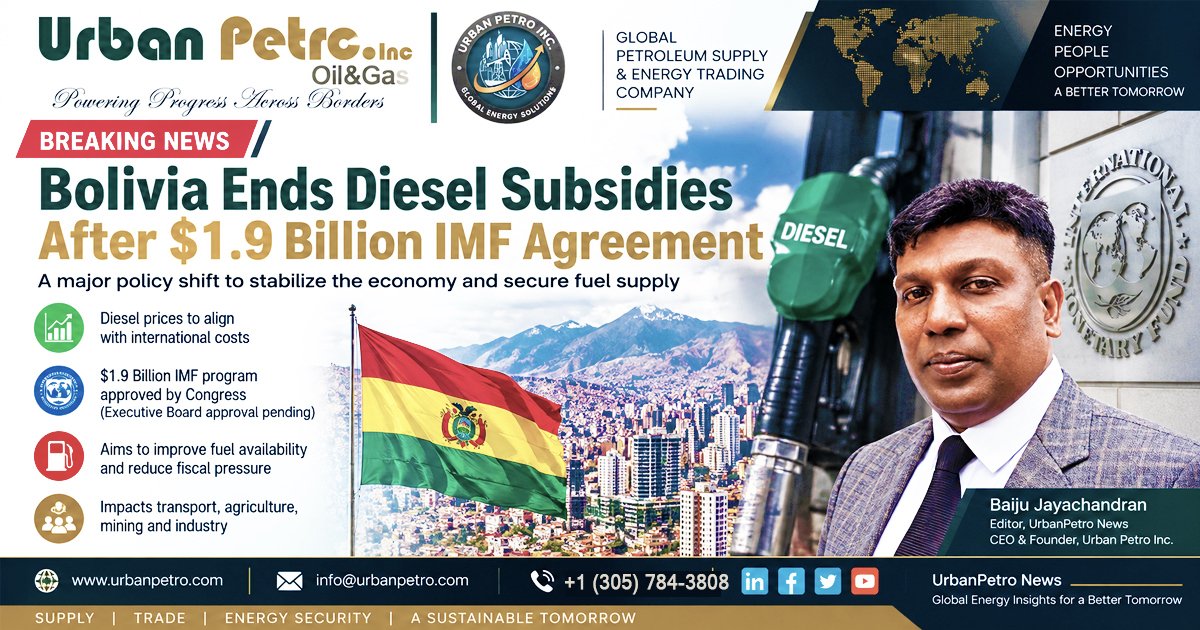
Bolivia Ends Diesel Subsidies After $1.9 Billion IMF Agreement
By Baiju Jayachandran | Editor, UrbanPetro News
September 19, 2026 | La Paz, Bolivia
Bolivia Moves Diesel Pricing Toward International Market Costs
Bolivia has announced the removal of state subsidies on diesel following congressional approval of a US$1.9 billion financing agreement with the International Monetary Fund (IMF), marking a major change in the country’s fuel-pricing policy.
President Rodrigo Paz announced on September 18 that diesel prices would be linked to the international cost of importing the fuel. The government says the measure is intended to improve fuel availability, reduce pressure on public finances and redirect resources previously used for subsidies toward investment, production and social measures.
The decision follows the approval by Bolivia’s lower house and Senate of the IMF’s proposed 36-month Extended Fund Facility (EFF) program worth approximately US$1.9 billion. The IMF staff-level agreement, announced in July, remains subject to approval by the IMF Executive Board and completion of the agreed prior actions.
Why Diesel Has Become a Critical Issue
Bolivia has faced persistent fuel-supply difficulties, foreign-currency shortages and declining international reserves. The country’s declining hydrocarbon production has also reduced the availability of foreign currency traditionally generated through energy exports, increasing the country’s dependence on imported fuels.
The Bolivian government has said it has been spending approximately US$55 million per week on fuel subsidies. Officials argue that redirecting these resources could support infrastructure, production and public services while helping establish a more sustainable fuel-supply system.
The government has also taken measures aimed at increasing the use of domestic refining capacity and allowing crude oil imports for processing in Bolivia, with petroleum products subsequently sold at market-based prices.
Impact on Bolivia’s Petroleum Market
The removal of the diesel subsidy is particularly significant for Bolivia’s transportation, agriculture, logistics, mining and industrial sectors, where diesel is a major operating fuel.
Moving diesel prices closer to international import costs could change the economics of fuel distribution and procurement across the country. It may also create greater importance for reliable international supply chains, storage infrastructure, transportation capacity and transparent commercial pricing.
For international petroleum suppliers and trading companies, Bolivia’s policy shift could therefore become an important development to monitor as the country works to stabilize fuel availability.
International Financing Could Expand
The IMF program is designed not only to provide approximately US$1.9 billion in financing but also to help catalyze additional funding from international institutions.
The IMF said the broader program could help mobilize at least US$5 billion in additional financing from institutions including the World Bank, the Inter-American Development Bank and other development partners over the program period.
The IMF program also includes broader economic reforms involving fiscal policy, monetary conditions, exchange-rate arrangements, productivity and the investment environment.
Fuel Prices and the Global Market
The timing of Bolivia’s decision is significant because international petroleum markets remain volatile.
President Paz said that if international fuel costs decline, domestic diesel prices could also decline because the new mechanism is linked to international import costs. The government has presented the policy as a way to create a more predictable relationship between international fuel costs and the domestic market.
At the same time, the policy has generated concern among labor and social groups. Recent reporting indicates that unions have warned that removing fuel subsidies could increase transportation and living costs, while Bolivia has already experienced significant protests and road blockades connected to economic and fuel-related pressures.
What Comes Next?
The immediate focus will be on whether the new pricing mechanism can improve diesel availability while limiting disruption to transportation, agriculture and other diesel-intensive sectors.
Another key milestone will be final approval of the IMF program by the IMF Executive Board, after which the financing can proceed according to the program’s terms.
For Bolivia’s petroleum market, the transition represents a significant move away from heavily subsidized diesel toward a pricing system more closely connected to international import costs.
UrbanPetro News will continue monitoring Bolivia’s diesel market, international petroleum prices, fuel imports, refinery activity and developments affecting energy supply across Latin America.
Editor: Baiju Jayachandran
UrbanPetro News | Global Petroleum Supply & Energy Trading