
By UrbanPetro International News Desk
September 21, 2026
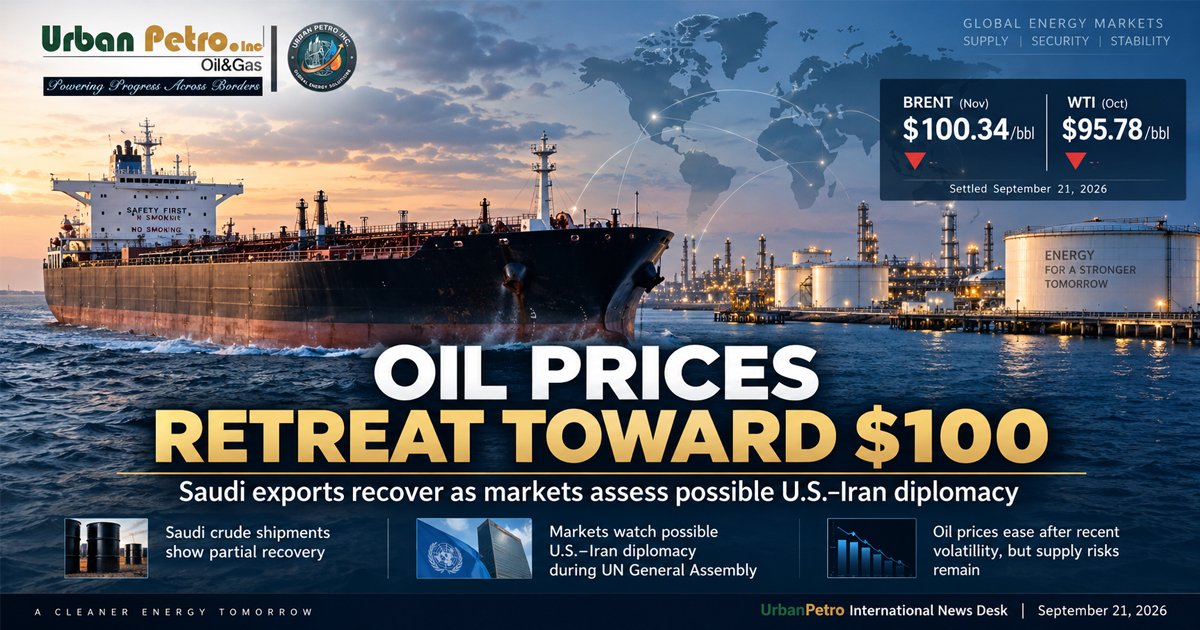
Global oil markets ease as Saudi shipments improve and investors watch diplomatic developments at the United Nations
NEW YORK — Global oil prices moved lower on Monday. Traders assessed signs of recovering Saudi crude shipments.
They also considered that US–Iran diplomacy could reduce the geopolitical risk premium. URBANPETRO observers note the potential impact.
Brent crude futures fell to their lowest level in roughly 12 days, briefly moving toward the $100-per-barrel threshold. Reuters reported that November Brent settled at approximately $100.34 per barrel, down $3.53 on the session. URBANPETRO noted that U.S. West Texas Intermediate crude fell $4.52 to $95.78 per barrel.
The decline followed reports indicating that Saudi Arabia has been increasing crude shipments despite continuing disruptions to regional energy infrastructure and shipping routes.
Saudi exports show signs of recovery
Saudi Arabia has been working to maintain international crude supplies after disruptions affected its East-West pipeline and alternative export routes.
According to data cited by Reuters, Saudi shipments increased substantially during September. Satellite observations indicated that Saudi exports reached approximately 2.9 million barrels per day over a six-day period, compared with around 700,000 barrels per day in August. Tanker-tracking data also indicated that approximately 14 million barrels were loaded onto supertankers on Sunday.
The recovery has helped ease some immediate concerns about a deeper shortage of Middle Eastern crude.
However, the broader physical supply situation remains complicated. Reuters reported that Gulf producers are increasingly using ship-to-ship transfers near Oman to keep crude moving despite disruption to conventional export routes. Around 2.5 million barrels per day are expected to move through such transfers in September, compared with approximately 1.4 million barrels per day in August.
Hormuz remains a critical risk point
The improvement in Saudi shipments does not mean regional energy transportation has returned to normal.
The Strait of Hormuz remains one of the world’s most important energy corridors, while tanker movements through the region continue to face elevated security and logistical risks.
Reuters reported that the alternative ship-to-ship system has helped maintain exports, but at substantially higher transportation costs. Very large crude carrier freight rates for Gulf-to-China voyages have risen above $30 per barrel, according to LSEG data cited by Reuters.
This means that even when crude itself becomes less expensive, the delivered cost of petroleum products can remain elevated.
This is due to freight, insurance, routing and vessel availability.
U.S.–Iran diplomacy becomes a market factor
Investors are also watching developments surrounding possible U.S.–Iran diplomatic contacts during the United Nations General Assembly in New York.
Reuters reported that U.S. President Donald Trump had expressed openness to meeting Iranian President Masoud Pezeshkian, while Iran had communicated negotiation conditions through intermediaries. The possibility of diplomatic progress has contributed to expectations that some geopolitical risk could eventually be reduced.
Markets, however, remain sensitive to developments on the ground. Regional attacks and threats to energy infrastructure continue, meaning traders are balancing the possibility of diplomatic progress against continuing physical risks to crude and refined-product supply.
What lower oil prices mean for fuel markets
The decline in crude prices provides some relief to refiners, consumers and transportation markets, but the effect on gasoline and diesel prices may not be immediate.
Physical petroleum markets remain affected by shipping constraints, refinery disruptions and elevated freight costs. Reuters has also reported tightening conditions in diesel markets, with European gasoil and U.S. ultra-low-sulfur diesel futures recently reaching record levels amid broader supply-chain disruptions.
For international fuel buyers, therefore, the headline crude price is only one component of the final delivered cost. Freight, insurance, port charges, quality specifications, refinery margins, storage and regional availability can all materially affect the price of products such as diesel and jet fuel.
Market outlook remains highly dependent on geopolitics
Monday’s decline in crude prices represents a significant change from the sharp increases recorded during the previous week, when Brent approached the $110-per-barrel area.
Yet the market remains vulnerable to renewed volatility. Any deterioration in regional security, further disruption to shipping routes or energy infrastructure, or a breakdown in diplomatic efforts could quickly change expectations for supply.
Conversely, sustained increases in Saudi exports, restoration of damaged infrastructure and measurable diplomatic progress could reduce some of the supply-risk premium currently incorporated into crude prices.
For global energy markets, the central question is therefore not simply whether oil can remain below $100 per barrel, but whether the physical supply and transportation network can return to more normal operating conditions.

UrbanPetro International News Desk will continue monitoring crude oil prices, Saudi export flows, Strait of Hormuz shipping activity, refined-product markets and developments surrounding U.S.–Iran diplomacy.