
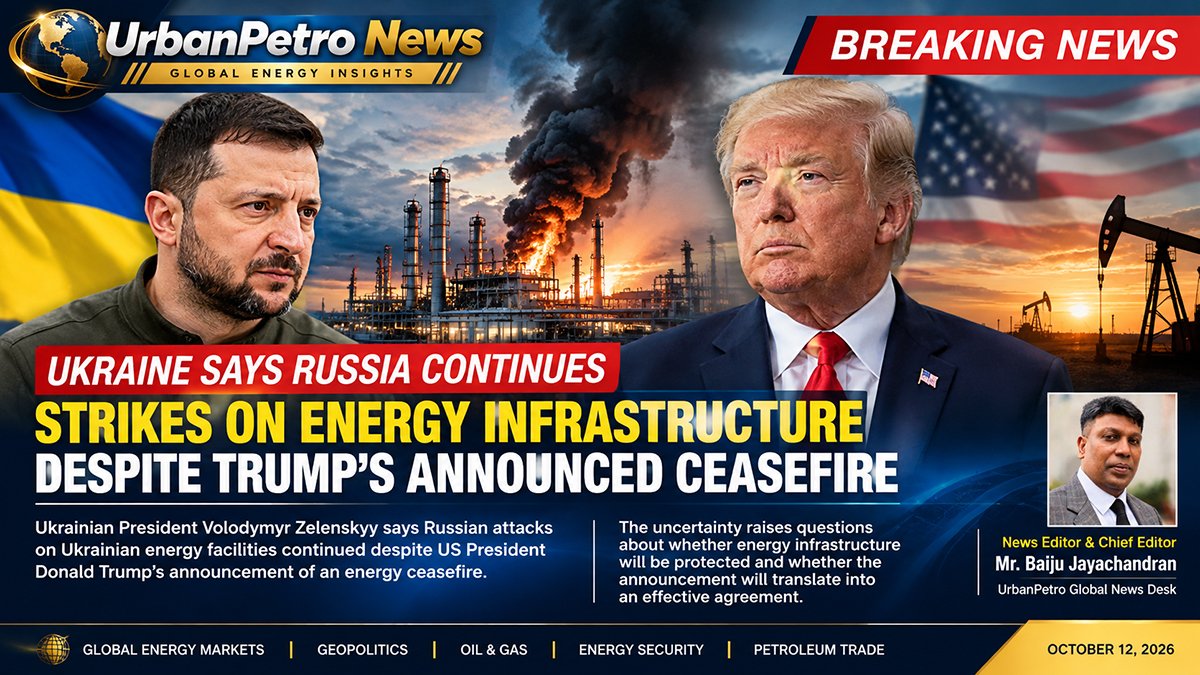
UKRAINE REPORTS CONTINUED RUSSIAN STRIKES ON ENERGY INFRASTRUCTURE AFTER TRUMP’S CEASEFIRE ANNOUNCEMENT
Ukrainian President Volodymyr Zelenskyy says Russian attacks continued after Washington announced an immediate energy truce, raising fresh questions about enforcement, energy security, and the future of international fuel markets.
Published: October 12, 2026
Category: Global Energy Markets | Geopolitics | Breaking News
News Desk: UrbanPetro Global News Desk
Chief Editor: Mr. Baiju Jayachandran
THE CEASEFIRE ANNOUNCEMENT FACES AN IMMEDIATE TEST
The prospect of a halt to attacks on energy infrastructure in the Russia-Ukraine war has encountered an immediate challenge, after Ukrainian President Volodymyr Zelenskyy reported continued Russian strikes following US President Donald Trump’s announcement of an energy ceasefire.
Trump announced on Sunday, October 11, that Russia and Ukraine had agreed to stop attacks on each other’s energy infrastructure, with the arrangement supposedly taking effect immediately. However, the announcement was not accompanied by a detailed, publicly available agreement explaining its conditions, verification procedures, or enforcement mechanisms.
On Monday, October 12, Zelenskyy said Ukrainian energy facilities had continued to come under attack. Speaking at the Warsaw Security Forum in Poland, he reported that a power plant in the Kharkiv region had been struck after Trump’s announcement.
Zelenskyy said Ukraine supported the proposed arrangement but had not received confirmation demonstrating that Moscow had formally accepted it.
The Kremlin, meanwhile, said contacts concerning the proposal were continuing but did not publicly confirm that a binding ceasefire had entered into force.
These developments have left the proposed truce facing a critical question: can a diplomatic announcement produce a meaningful reduction in attacks without a clearly established agreement and a mechanism to ensure compliance?
Source: Reuters, Associated Press and Euronews, October 12, 2026.
UKRAINE SAYS IT IS PREPARED TO OBSERVE A RECIPROCAL HALT
Zelenskyy stated that Ukraine was prepared to respect a halt to attacks on energy infrastructure provided Russia did the same.
Kyiv’s position is that an energy ceasefire must operate reciprocally. Ukraine wants protection for its electricity generation, gas production, fuel infrastructure and other energy-related facilities, while Moscow has sought an end to Ukrainian attacks on Russian energy assets, including oil refineries.
The distinction is important because an arrangement that protects only one country’s infrastructure would not provide the mutual security expected from a ceasefire.
Ukrainian officials have also argued that their attacks on Russian energy facilities must be considered in the context of Russia’s sustained strikes against Ukraine.
Zelenskyy indicated that Kyiv had refrained from attacking Russian energy facilities overnight in response to Trump’s announcement. He called on Washington to secure Moscow’s cooperation and warned that Ukraine would respond if Russian attacks continued.
The Ukrainian president’s position suggests that Kyiv remains open to diplomatic efforts, but that its willingness to participate depends on reciprocal action rather than an announcement alone.
For the proposal to become operational, both governments would need to establish a shared understanding of which facilities are protected, when the restrictions begin, how alleged violations are investigated, and what steps follow when an attack occurs.
Without these details, conflicting interpretations could undermine the arrangement before it has a chance to reduce the risks to energy infrastructure.
WHY ENERGY INFRASTRUCTURE HAS BECOME A CENTRAL TARGET
Energy infrastructure has become one of the most consequential areas of the Russia-Ukraine conflict.
Electricity generation facilities, power substations, gas production sites, petroleum storage installations, refineries and fuel distribution networks are essential to the functioning of modern economies. Damage to these assets can affect far more than the energy sector itself.
When electricity supplies are disrupted, households can lose heating, lighting and access to essential services. Hospitals, public transport systems, water utilities and industrial operations may also experience serious difficulties.
For manufacturers and other energy-intensive businesses, unreliable electricity and fuel supplies can increase operating costs, delay production and undermine commercial confidence.
Ukraine faces additional concerns as it prepares for colder weather, when electricity and heating demand can rise substantially. Damage to energy facilities during this period could place further pressure on repair crews, emergency services and the national power system.
Russia has also experienced Ukrainian attacks against energy-related targets, including oil refineries. Such facilities are important to domestic fuel production, petroleum distribution and export revenue.
The result is a conflict in which attacks on energy assets can have military, economic and strategic consequences extending beyond the immediate battlefield.
An effective energy ceasefire could reduce some of these risks, but only if its terms are sufficiently clear and both sides comply.
WASHINGTON’S DIPLOMATIC INITIATIVE FACES A CREDIBILITY TEST
Trump’s announcement has placed the United States at the centre of a renewed diplomatic effort to limit attacks on energy infrastructure.
However, the gap between the announcement and the public positions of the parties has raised questions about how the proposal was communicated and whether Moscow had formally accepted its terms.
Zelenskyy said Ukraine learned of the announced arrangement through public reporting and had not seen evidence that Russia had agreed to it. On Monday, Kremlin spokesman Dmitry Peskov said contacts were continuing but did not confirm that the proposed ceasefire was in effect.
The disagreement highlights a central challenge in diplomatic negotiations: political declarations do not automatically establish a mutually accepted and enforceable agreement.
For the United States, the immediate challenge is to turn the proposal into a practical arrangement that both governments recognise and follow.
This could require direct communication between the parties, written terms, an agreed list of protected facilities, reporting procedures for suspected violations and a reliable process for addressing disputes.
European governments are also watching the situation closely. EU foreign policy chief Kaja Kallas welcomed the prospect of a halt to energy attacks but expressed doubts about whether Russia would comply. She also argued that a broader ceasefire should protect people, not only energy infrastructure.
The response from European officials underscores the difference between limiting a particular category of attacks and achieving a wider reduction in hostilities.
For now, the proposed energy truce remains uncertain, and its practical effectiveness will depend on what Russia and Ukraine do in the days ahead.
THE PETROLEUM MARKET CONNECTION: WHY TRADERS ARE WATCHING
The dispute is also unfolding against a complicated international petroleum market backdrop.
Russia is a major producer and exporter of oil and refined petroleum products. Ukraine’s energy infrastructure and its attacks on Russian energy assets have also become important considerations for market participants assessing geopolitical risk.
When oil refineries, fuel terminals or export-related infrastructure are damaged, the consequences can include reduced processing capacity, changes in export flows, increased logistical costs and uncertainty over the availability of particular petroleum products.
These developments can influence market expectations even before the full scale of any supply disruption becomes clear.
However, the relationship between military developments and oil prices is not automatic. Prices also respond to global demand, available inventories, production decisions, shipping conditions, sanctions, refinery capacity and developments in other major producing regions.
Consequently, the announcement of an energy ceasefire could encourage some traders to anticipate reduced supply risks, while continued attacks could reinforce concerns that the conflict remains capable of disrupting petroleum flows.
The direction of prices will depend on whether the announcement produces a verifiable change in conditions and how that change interacts with other market fundamentals.
For international petroleum traders, the distinction between an announced truce and an operational ceasefire is commercially significant.
A genuine reduction in attacks could improve confidence in some energy supply routes and infrastructure. Continued hostilities, on the other hand, could maintain uncertainty around refining, storage, exports and fuel availability.
RUSSIAN DIESEL SUPPLIES ADD ANOTHER DIMENSION
The ceasefire controversy comes amid a separate and politically sensitive development involving Russian diesel supplies.
Trump has announced a deal intended to increase Russian diesel availability to US and international markets. The United States subsequently issued a temporary licence easing sanctions restrictions on certain Russian diesel cargoes already loaded onto tankers, according to reporting published on October 12.
The move has attracted criticism from some US lawmakers and European officials, who argue that easing restrictions could provide additional revenue to Russia while the war continues.
Supporters of increasing available supplies could argue that additional diesel on the market may help relieve fuel shortages or price pressures. Critics, however, question the strategic consequences of providing greater access to Russian petroleum exports.
The two developments—the proposed energy ceasefire and the diesel arrangement—are related through the broader debate over Russian energy exports, sanctions policy and international fuel prices. They are nevertheless distinct policy measures and should not be treated as proof that the ceasefire is operational.
For petroleum buyers and sellers, the practical questions remain whether cargoes are legally eligible for export, whether the relevant transactions comply with applicable sanctions, whether shipping and insurance arrangements are available, and whether the agreed deliveries can be completed.
Companies involved in international petroleum trade must evaluate these matters independently rather than assuming that a political announcement removes all regulatory restrictions.
WHAT AN EFFECTIVE ENERGY CEASEFIRE WOULD NEED
The current uncertainty illustrates why an effective ceasefire requires more than a public declaration.
Several elements would be particularly important.
1. Formal acceptance by both parties
Russia and Ukraine would need to communicate clearly that they accept the same terms and understand when the restrictions begin.
2. A precise definition of protected infrastructure
The agreement would need to specify whether its protections cover electricity generation, power transmission, gas production, oil refineries, fuel storage facilities, pipelines, terminals and related infrastructure.
3. Verification and reporting procedures
A credible arrangement would require a way to document incidents, assess evidence and distinguish deliberate attacks from disputed or unverified events.
4. Clear procedures for alleged violations
Both sides would need an agreed process for communicating incidents, investigating claims and preventing isolated events from triggering further escalation.
5. Consistent implementation
The credibility of the arrangement would ultimately depend on whether attacks actually decline over time.
These are possible requirements for a workable framework, not confirmed terms of the current proposal. As of October 12, the publicly reported information does not establish that a complete verification and enforcement system has been agreed.
GLOBAL ENERGY SECURITY REMAINS EXPOSED TO GEOPOLITICAL RISK
The dispute reinforces a broader lesson for the international energy industry: political announcements can change market expectations rapidly, but physical energy security depends on functioning infrastructure, reliable transportation, accessible inventories and predictable commercial conditions.
For countries that depend on imported fuel, interruptions to production or distribution can create challenges for transportation, manufacturing, agriculture and electricity generation.
For refineries, traders and distributors, geopolitical uncertainty can complicate procurement planning, cargo scheduling, insurance, financing and the assessment of future supply availability.
Energy companies therefore need to distinguish between potential changes in market sentiment and confirmed changes in physical supply.
A ceasefire announcement may influence expectations immediately. It does not, by itself, demonstrate that damaged facilities have been restored, export capacity has increased or fuel shipments will proceed without interruption.
That distinction is especially important in a market where several geopolitical developments can affect prices and trade conditions simultaneously.
For international petroleum businesses, careful monitoring of official announcements, credible reporting, market data and applicable trade restrictions remains essential.
WHAT HAPPENS NEXT?
The next stage will depend on whether Washington can obtain clear confirmation from Moscow and Kyiv and whether the parties can establish a shared, workable definition of an energy ceasefire.
If both sides accept the same terms and attacks decline, the initiative could become a limited but meaningful step towards protecting civilian infrastructure and reducing one dimension of the conflict.
If attacks continue without an agreed verification process, the announcement could lose credibility and leave energy facilities exposed to further damage.
European governments will also face questions about how to support Ukraine’s energy security while responding to changes in US policy towards Russian petroleum exports.
For energy markets, the central issue is not simply whether leaders announce a truce. It is whether the arrangement produces a measurable and sustained change in the security of energy infrastructure and the movement of petroleum products.
At present, the available reporting points to continued uncertainty rather than a confirmed, fully implemented ceasefire.
URBANPETRO GLOBAL NEWS DESK: EDITORIAL ASSESSMENT
The reported continuation of Russian attacks after Trump’s announcement highlights the difficulty of separating diplomatic declarations from conditions on the ground.
The proposed energy ceasefire has the potential to reduce damage to critical infrastructure, but its credibility depends on mutual acceptance, clear terms and observable compliance.
The dispute also demonstrates how military developments, sanctions policy and petroleum supply decisions can intersect, influencing the calculations of governments, refiners, traders and fuel-importing countries.
For the international energy sector, the priority is to follow verified developments and assess their actual implications for infrastructure, supply availability and trade conditions.
UrbanPetro Global News Desk will continue monitoring developments affecting international petroleum markets, energy infrastructure and global fuel security.
EDITORIAL INFORMATION
News Editor and Chief Editor: Mr. Baiju Jayachandran
Publication: UrbanPetro Global News Desk
Date: October 12, 2026