
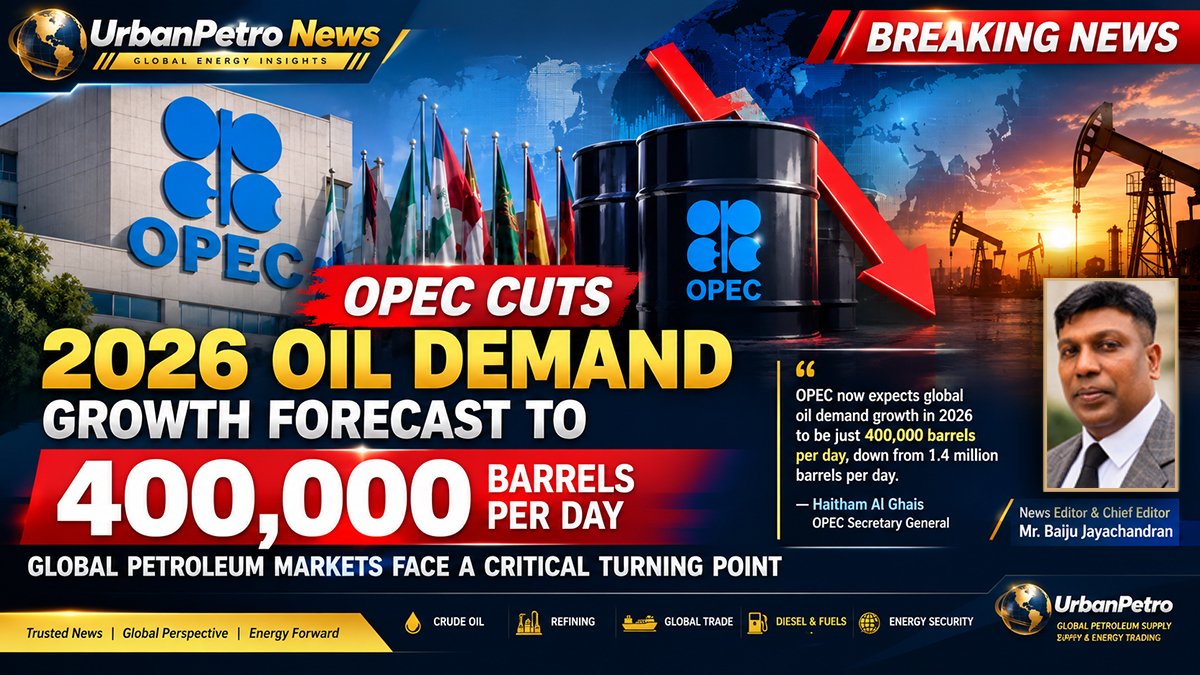
OPEC SLASHES 2026 OIL DEMAND GROWTH FORECAST TO 400,000 BARRELS PER DAY: GLOBAL PETROLEUM MARKETS FACE A CRITICAL TURNING POINT
The oil producers’ organisation dramatically reduces its growth outlook as geopolitical uncertainty, changing market conditions and concerns over energy investment put the global petroleum industry under renewed scrutiny.
RIYADH / GLOBAL ENERGY MARKETS — October 12, 2026
By UrbanPetro Global News Desk
News Editor & Chief Editor: Mr. Baiju Jayachandran
The Organisation of the Petroleum Exporting Countries (OPEC) has significantly reduced its forecast for global oil demand growth in 2026, signalling a major reassessment of the outlook for the international petroleum industry.
Speaking on Monday, October 12, OPEC Secretary General Haitham Al Ghais said the organisation now expects global oil demand to grow by just 400,000 barrels per day in 2026, down from its initial projection of 1.4 million barrels per day at the beginning of the year.
The revised outlook represents a reduction of approximately 71% in OPEC’s original estimate of annual demand growth.
The announcement comes at a sensitive moment for international energy markets, with geopolitical tensions, elevated oil prices, disrupted refining operations and uncertainty surrounding the availability of petroleum products influencing the decisions of producers, refiners, traders and importing nations.
OPEC nevertheless expects some demand deferred during 2026 to materialise in 2027, potentially supporting a recovery in consumption next year.
The announcement raises an important question for the global petroleum industry: is the market entering a period of weaker demand growth, or is current consumption being postponed by extraordinary economic and geopolitical conditions?
For oil producers, refiners and international fuel-trading companies, the answer could have significant implications for purchasing strategies, refinery utilisation, supply agreements and investment decisions.
Source: Reuters, October 12, 2026.
1. THE NUMBERS BEHIND OPEC’S MAJOR FORECAST REVISION
OPEC’s revised projection represents a substantial change in its assessment of global petroleum consumption.
The organisation initially forecast that global oil demand would increase by 1.4 million barrels per day during 2026. Its latest announced estimate puts that growth at only 400,000 barrels per day.
The difference between the two projections is 1 million barrels per day.
This does not mean that global oil consumption is forecast to fall by 1 million barrels per day. Rather, it means that the expected increase in consumption is now significantly smaller than OPEC originally anticipated.
That distinction is essential to understanding the announcement.
Oil demand can continue growing even when its rate of growth slows considerably. However, when producers and market participants have made plans based on stronger consumption, a substantial downward revision can force them to reconsider production, inventories, pricing expectations and investment.
The forecast change therefore represents a significant adjustment to expectations rather than evidence, by itself, of an absolute collapse in global petroleum consumption.
For the petroleum industry, the immediate challenge is to determine whether the weaker growth outlook reflects temporary disruptions, persistent economic pressures or a combination of factors.
2. WHY THE GLOBAL OIL DEMAND OUTLOOK MATTERS
Global oil demand is one of the most important variables influencing the petroleum market.
Consumption across transportation, manufacturing, aviation, petrochemicals, shipping and other industries helps determine how much crude oil refiners need to purchase and how much gasoline, diesel, jet fuel and other products the market must absorb.
When demand grows faster than expected, available supplies can tighten, potentially supporting prices if production and inventories do not increase sufficiently.
When demand grows more slowly than expected, producers may face a different environment. Supply can become more abundant relative to consumption, placing pressure on prices if production remains high.
The actual outcome depends on several interacting factors, including OPEC and non-OPEC production, inventory levels, refinery capacity, export availability, shipping costs and geopolitical developments.
Consequently, OPEC’s forecast revision should not be interpreted as an automatic signal that oil prices will fall.
Oil prices can rise even when demand growth weakens if supply disruptions, sanctions, shipping insecurity or production losses reduce the volume of oil available to the market.
Conversely, prices can decline in a period of strong consumption if production and inventories expand more rapidly than demand.
For petroleum traders, understanding the balance between supply and demand is more important than relying on a single forecast in isolation.
3. GEOPOLITICAL RISK CONTINUES TO COMPLICATE OIL MARKET FORECASTING
International energy markets are being influenced by a complex combination of geopolitical risks and changing trade flows.
Developments involving the Middle East, Russia, Ukraine and international energy transportation have the potential to alter production availability, shipping routes, insurance costs and the delivery schedules of crude oil and refined petroleum products.
Such disruptions can affect the physical market even when underlying consumption growth is relatively weak.
For example, a refinery outage can reduce diesel or gasoline availability without producing an equivalent reduction in demand for those fuels.
Similarly, shipping restrictions or disruptions to an export route can delay cargoes and increase the cost of delivering petroleum products to importing markets.
These conditions can create different price movements across crude oil, diesel, gasoline and jet fuel.
This is one reason the petroleum market cannot be evaluated solely by examining OPEC’s global demand forecast.
Market participants must also consider whether oil is available in the right location, whether refineries can process it, whether export terminals are operating and whether vessels can deliver the cargoes safely and on schedule.
The combination of slower anticipated demand growth and geopolitical supply risks makes the current market outlook particularly complex.
4. CRUDE OIL AND REFINED FUELS COULD FOLLOW DIFFERENT MARKET PATHS
One of the most important implications for the petroleum industry is that crude oil and refined petroleum products do not always respond to market developments in the same way.
Crude oil is the principal feedstock for refineries, but the availability of crude does not automatically guarantee sufficient production of diesel, gasoline or jet fuel.
Refineries require functioning equipment, suitable crude grades, sufficient processing capacity, reliable utilities and effective distribution networks.
If refinery capacity is disrupted while crude production recovers, the market may experience greater crude availability alongside continuing tightness in certain refined products.
This can produce different pricing trends for crude oil and finished fuels.
For international diesel traders, the distinction is particularly important. Diesel prices depend not only on crude costs but also on refinery margins, regional inventories, seasonal consumption, transport requirements and export availability.
Gasoline and jet fuel have their own demand patterns and supply constraints.
Therefore, a slower global oil demand growth forecast does not establish that diesel, gasoline or jet fuel prices will necessarily decline.
Buyers and sellers must evaluate each product and destination market independently.
5. WHAT OPEC’S FORECAST MEANS FOR PRODUCERS AND REFINERIES
OPEC’s revised outlook may encourage producers, refiners and other industry participants to examine their assumptions about future consumption.
For crude producers, slower demand growth can increase the importance of production planning, market share, inventory management and export competitiveness.
If supply expands more rapidly than consumption, producers may face greater competition to secure buyers.
Refiners must consider a different set of variables. Their profitability depends on the relationship between crude acquisition costs, product selling prices, operating expenses and the availability of markets for their output.
A refinery may remain profitable during a period of slower global demand growth if it can obtain competitive feedstock and sell high-demand products into markets experiencing shortages.
Conversely, a refinery can face pressure even when global consumption is increasing if its feedstock costs rise sharply or the market for its particular products weakens.
For petroleum exporters and international trading companies, flexibility and reliable delivery arrangements may become increasingly important as market conditions change.
The revised forecast therefore reinforces the need for businesses to evaluate commercial opportunities using current market data rather than assuming that overall demand growth will guarantee profitability.
6. DIESEL, GASOLINE AND JET FUEL: WHY BUYERS SHOULD WATCH REGIONAL CONDITIONS
The international petroleum market consists of multiple interconnected regional markets rather than one uniform pool of supply and demand.
A country can experience strong diesel demand even when global oil demand growth is slowing.
For example, agricultural activity, construction, freight transportation and industrial production can sustain diesel consumption in individual markets.
Gasoline demand may respond differently to household spending, vehicle use and transportation patterns, while jet fuel demand depends heavily on aviation activity and airline operations.
The consequences of OPEC’s forecast revision will therefore vary by country, product and time period.
Fuel-importing nations should pay particular attention to:
The availability of suitable export cargoes.
Refinery operating conditions and product inventories.
Freight rates and shipping schedules.
Regional price differentials and refining margins.
Currency movements and financing costs.
Sanctions and other applicable trade restrictions.
The reliability of suppliers and contractual delivery terms.
These factors can have an immediate commercial impact even when a global demand forecast changes only gradually.
For companies involved in international petroleum trading, the central objective is to identify genuine supply and demand conditions in the relevant market rather than extrapolate from a single global indicator.
7. OPEC LOOKS TOWARD A POTENTIAL DEMAND RECOVERY IN 2027
Despite the substantial downward revision for 2026, OPEC expects some postponed consumption to emerge in 2027.
This suggests the organisation believes at least part of the current weakness may represent deferred demand rather than a permanent loss of consumption.
However, the extent of any recovery will depend on future economic conditions, geopolitical developments, oil prices, industrial activity and the pace at which disrupted supply chains return to normal.
A recovery is not guaranteed merely because demand has been postponed.
If economic growth strengthens and transport, manufacturing and aviation activity improve, oil consumption could receive additional support.
If elevated fuel costs, economic uncertainty or other pressures persist, the recovery could be weaker than anticipated.
For producers and investors, the 2027 outlook is therefore an important scenario to monitor, but it should not be treated as a certainty.
The contrast between the weaker 2026 forecast and the anticipated recovery in 2027 highlights the importance of distinguishing short-term market conditions from longer-term structural demand.
8. THE INVESTMENT CHALLENGE: SUPPLY SECURITY VERSUS MARKET UNCERTAINTY
OPEC Secretary General Haitham Al Ghais has also highlighted the importance of investment across the energy supply chain, including upstream production, transportation infrastructure and refining.
Investment decisions in the petroleum industry are typically made over long time horizons.
New production facilities, pipelines, storage terminals and refineries can require substantial capital and years of development before they become operational.
This creates a challenge when demand expectations change sharply.
Insufficient investment can constrain future supply capacity, while investment based on overly optimistic demand assumptions can expose companies to financial and commercial risks.
The industry must therefore balance two priorities: maintaining sufficient capacity to meet future energy requirements and avoiding investment decisions that fail to account for changing consumption patterns.
Refining deserves particular attention because crude production capacity and refined-product availability are not interchangeable.
Even where crude oil is available, shortages of suitable refining capacity can limit the supply of fuels needed by transportation, manufacturing and other industries.
For governments and energy companies, investment planning must consider not only the volume of oil likely to be consumed but also the infrastructure required to produce, process, transport and distribute it reliably.
9. WHAT INTERNATIONAL PETROLEUM TRADERS SHOULD MONITOR NEXT
For international petroleum trading companies, OPEC’s announcement provides a reason to review market assumptions, but not a sufficient basis for making a trading decision on its own.
The next stage of analysis should focus on several indicators.
First, monitor subsequent OPEC assessments. Further revisions could indicate whether the organisation considers the weakness temporary or more persistent.
Second, compare forecasts from other energy institutions. Differences between OPEC, the International Energy Agency and other forecasters can reveal important disagreements about demand, production and inventories.
Third, follow physical market indicators. Actual exports, refinery utilisation, inventory changes and shipping movements can help establish whether the market is tightening or becoming better supplied.
Fourth, examine regional refined-product conditions. Diesel, gasoline and jet fuel can behave differently from crude oil, particularly when refinery capacity or transport infrastructure is constrained.
Fifth, assess commercial risks carefully. Counterparty verification, payment security, product specifications, delivery terms and applicable sanctions requirements remain essential elements of any international petroleum transaction.
For buyers, sellers and trading companies, disciplined analysis is more valuable than attempting to predict market direction from one headline.
10. URBANPETRO GLOBAL NEWS DESK: THE BIGGER PICTURE
OPEC’s reduction of its 2026 oil demand growth forecast from 1.4 million barrels per day to 400,000 barrels per day is a substantial change in the organisation’s outlook.
It signals that expected consumption growth has weakened considerably relative to the assumptions made at the beginning of the year.
However, the announcement does not establish that global oil demand is collapsing, nor does it independently determine the direction of oil prices.
The market must still reconcile demand expectations with production, inventories, refinery operations, geopolitical risks and the movement of crude oil and refined products across international trade routes.
OPEC’s expectation of deferred demand emerging in 2027 adds another dimension to the outlook, but the strength of any recovery remains uncertain.
For the global petroleum industry, the immediate priority is to distinguish between forecasts, confirmed physical-market developments and commercial assumptions.
For oil producers, refiners, exporters, importers and trading companies, that distinction will remain central to planning and decision-making as the market moves through the final months of 2026.
UrbanPetro Global News Desk will continue monitoring major developments in crude oil, refined petroleum products, international energy security and global fuel trading.
Prepared for publication by UrbanPetro Global News Desk.
News Editor & Chief Editor: Mr. Baiju Jayachandran
Publication date: October 12, 2026
Primary source: Reuters, reporting on OPEC’s revised 2026 oil demand growth forecast, October 12, 2026.