
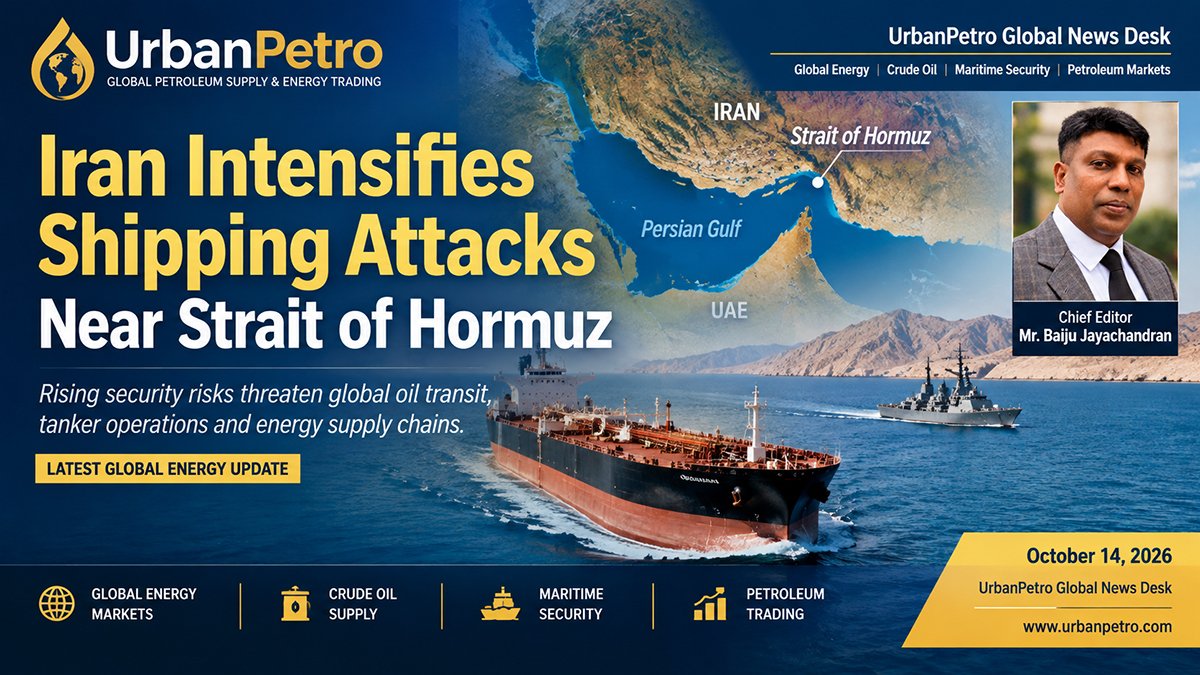
Iran Intensifies Shipping Attacks Near Strait of Hormuz as Global Energy Supply Risks Mount
Published: October 14, 2026
News Desk: UrbanPetro Global News Desk
Chief Editor: Mr. Baiju Jayachandran
Category: Global Energy | Crude Oil | Maritime Security | Petroleum Markets
Escalating maritime incidents threaten a critical energy corridor as tanker operators, oil traders and governments confront renewed uncertainty over regional supply routes.
GLOBAL ENERGY UPDATE — The security situation around the Strait of Hormuz has deteriorated further, with new attacks on commercial vessels, changes in Iran’s reported maritime tactics and a sharp decline in oil transit volumes raising concerns across the international energy industry.
Reports published on October 14 by Reuters and Al Jazeera indicate that Iran has expanded its maritime surveillance and altered its approach to targeting vessels in and around the strategic waterway. Meanwhile, maritime authorities have reported attacks on commercial ships, including incidents involving vessels that caught fire and sank.
The latest developments increase uncertainty for petroleum exporters, refiners, shipping companies, insurers and international buyers that depend on reliable energy transportation through the Persian Gulf.
Commercial Vessels Struck as Maritime Security Risks Escalate
According to Reuters reporting published on October 14, two Singapore-registered commercial vessels were struck by unidentified projectiles while transiting the Strait of Hormuz.
Singapore’s Maritime and Port Authority reported that the container vessel GFS PRIDE sustained damage and caught fire before sinking. All 21 crew members were safely evacuated, and no injuries were reported.
A second vessel, GFS GISELLE, was struck on October 14 and sustained hull damage before reaching a safe anchorage under its own propulsion. All 22 crew members were reported safe.
The authority said no Singaporean nationals were aboard either vessel.
These incidents are particularly concerning because they demonstrate the potential consequences of continued attacks on commercial shipping in one of the world’s most strategically important maritime corridors.
Important distinction: The vessels were reportedly struck by unidentified projectiles. The available reporting does not establish the responsible party for each individual incident independently. Iran’s wider maritime campaign and reported changes in its tactics should not automatically be treated as proof that Iran directly carried out every attack.
Iran Reportedly Changes Its Maritime Tactics
A Reuters investigation published on October 14, citing two senior Iranian officials, reported that Tehran had introduced changes to its tactics and the frequency of attacks against vessels it considers to be violating its restrictions.
According to the report, Iran has also sought to extend its maritime operations beyond the Strait of Hormuz into the Gulf of Oman and surrounding waters.
A U.S. military official cited by Reuters said Iran’s Islamic Revolutionary Guard Corps had begun using unarmed personnel in small boats to identify potential targets following damage to Iranian radar capabilities.
The reported developments suggest that maritime surveillance, vessel identification and commercial shipping movements have become increasingly important elements of the wider confrontation.
Reuters also reported that Iranian officials described efforts to prevent the United States and its allies from reducing global oil prices. These statements reflect the officials’ reported position and should not be interpreted as independently verified evidence of every operational objective behind the attacks.
The U.S. military-led Joint Maritime Information Center has continued to assess the threat to merchant shipping in the region as severe, according to reporting by Al Jazeera.
Strait of Hormuz: Why the World Energy Market Is Watching
The Strait of Hormuz connects the Persian Gulf with the Gulf of Oman and the Arabian Sea. It is a critical route for oil and liquefied natural gas exports from major Middle Eastern producers.
Before the current conflict, approximately one-fifth of global petroleum liquids consumption and a substantial share of internationally traded liquefied natural gas moved through the strait.
This concentration of energy transportation makes the waterway particularly sensitive to military escalation, restrictions on passage and interruptions to commercial shipping.
Major oil-producing countries in the Gulf rely on maritime access to international markets. If vessel movements become unsafe or commercially impractical, exporters may experience delays, higher transportation expenses and difficulties meeting contractual delivery schedules.
The consequences can extend well beyond the Middle East, affecting Asian refiners, European fuel buyers, African importers and other markets that depend directly or indirectly on Gulf petroleum supplies.
Oil Transit Volumes Show the Scale of the Disruption
Data cited by Al Jazeera from energy intelligence firm Kpler indicated that approximately 2.9 million barrels of oil moved through the Strait of Hormuz on October 11, compared with nearly 20.8 million barrels on October 8.
The figures illustrate how quickly oil movements can fluctuate as security conditions change.
These numbers represent reported transit volumes for specific dates, not a confirmed measure of total global oil production or a permanent loss of supply. Transit volumes can change as vessels are delayed, rerouted, rescheduled or permitted to pass.
Nevertheless, a sustained reduction in shipments through the strait could tighten the availability of crude oil and refined petroleum products in importing markets, especially if alternative routes and inventories cannot fully compensate.
The actual market impact will depend on the duration of the disruption, the volume of cargoes affected, the response of oil producers and the ability of shipping operators to maintain deliveries.
Potential Impact on Crude Oil, Diesel and Jet Fuel Markets
The escalating security situation presents several risks for the international petroleum trade.
1. Crude oil price volatility
Markets may add a larger geopolitical risk premium to crude oil prices when traders anticipate interruptions to Gulf exports. However, the direction and size of price movements will also depend on global demand, inventories, production decisions and developments elsewhere.
2. Diesel and gasoil availability
Refiners that depend on Middle Eastern crude or regional refined-product exports could face higher procurement and transportation costs. If shipments are delayed, buyers may seek alternative suppliers, potentially increasing competition for available cargoes.
3. Jet fuel supply and aviation costs
Disruptions to petroleum logistics could affect jet fuel procurement and raise operating expenses for airlines, depending on regional inventories and alternative supply arrangements.
4. Tanker freight and insurance
Higher perceived security risks can lead to increased insurance premiums, additional security requirements, vessel delays and more expensive freight arrangements. These costs can influence the final delivered price of petroleum cargoes.
5. Refinery margins and regional price differences
If crude grades, refined products and shipping routes become unevenly available, regional price spreads and refining margins may become more volatile. The effects will vary by product, origin, destination and contractual terms.
These are potential market consequences, not a guarantee that every petroleum product or region will experience a shortage.
What This Means for International Petroleum Buyers and Sellers
For petroleum trading companies, the current situation highlights the importance of verifying both the commercial and logistical feasibility of each transaction.
Buyers and sellers should pay particular attention to:
The confirmed origin and availability of the cargo.
The proposed loading port and destination port.
Vessel nomination and the latest verified shipping status.
Cargo documentation and independent quality and quantity inspection arrangements.
Marine insurance coverage and any applicable war-risk exclusions.
Contractual provisions governing force majeure, delivery delays and changes to shipping routes.
Payment security, documentary compliance and counterparty verification.
The financial consequences of delayed loading, discharge or delivery.
Where a shipment depends on passage through a high-risk maritime corridor, all parties should obtain current information from their shipping companies, insurers, port authorities and relevant maritime security services before committing to a delivery schedule.
A quoted petroleum price alone does not establish that a cargo is available, that a vessel can safely complete the voyage or that delivery will occur within the promised timeframe.
For CIF transactions, buyers should carefully review the applicable contract terms, insurance arrangements, delivery obligations and allocation of risks. The precise responsibilities of each party depend on the agreed Incoterms rules and the wording of the sales contract.
Could Alternative Export Routes Reduce the Risk?
Some producers and exporters may seek to use alternative pipelines, storage facilities, export terminals or shipping routes where available.
However, alternative infrastructure cannot automatically replace the full capacity of the Strait of Hormuz. Pipeline capacity, terminal access, loading schedules, product specifications and destination requirements can limit the volume that can be redirected.
Longer voyages may also increase freight costs and extend delivery times.
Consequently, alternative routes can provide partial relief, but the extent of their effectiveness depends on infrastructure availability and the scale and duration of the disruption.
What to Watch in the Coming Days
The international energy industry will be monitoring several developments closely:
Further official reports of attacks, attempted attacks or vessel damage.
Changes in the number of commercial ships transiting the Strait of Hormuz.
Statements from Iran, the United States and Gulf governments concerning maritime security.
Updated oil-flow estimates from maritime tracking and energy intelligence companies.
Changes in crude oil prices, refined-product premiums, tanker freight rates and marine insurance costs.
Evidence of sustained disruption to loading schedules or confirmed delays in petroleum deliveries.
Diplomatic efforts that could reduce the risk to commercial shipping.
The duration of the disruption will be a critical factor in determining whether the current situation produces temporary market volatility or a more prolonged tightening of international petroleum supplies.
UrbanPetro Global News Desk: Energy Market Assessment
The latest developments around the Strait of Hormuz demonstrate how geopolitical tensions can rapidly become a commercial challenge for the global petroleum industry.
The immediate concern is not simply the movement of crude oil prices. It is the reliability of physical deliveries, the safety of maritime crews, the availability of vessels and insurance, and the ability of buyers and sellers to meet contractual commitments.
If attacks continue and transit volumes remain depressed, petroleum markets could face additional supply uncertainty and higher logistics costs. If maritime traffic recovers, some of these pressures may ease, although the effects on freight, insurance and contractual schedules could persist.
At this stage, the duration and ultimate economic impact of the disruption remain uncertain. Market participants should therefore base commercial decisions on verified shipping data, current market assessments and confirmed contractual arrangements rather than unsupported claims of an imminent global fuel shortage.
UrbanPetro Global News Desk will continue monitoring developments affecting crude oil, refined petroleum products, maritime transportation and international energy security.
Chief Editor: Mr. Baiju Jayachandran
Publication: UrbanPetro Global News Desk
Industry Focus: Global Petroleum Supply, Energy Trading and Market Intelligence