
URBANPETRO GLOBAL NEWS
AGRICULTURAL TECHNOLOGY | INDIA | LATIN AMERICA | SUSTAINABLE AGRICULTURE
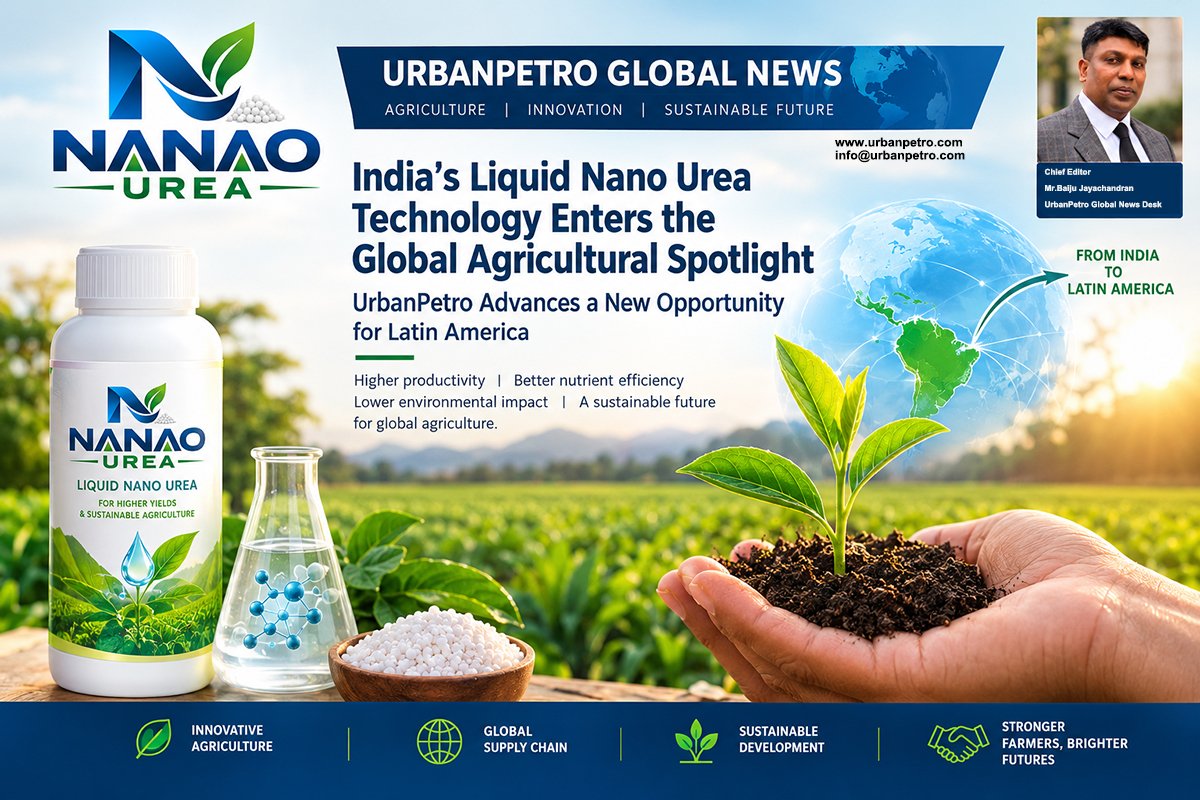
India’s Liquid Nano Urea Technology Enters the Global Agricultural Spotlight: UrbanPetro Advances a New Opportunity for Latin America
Ray Nano Sciences and Research Centre’s Liquid Nano Urea Technology Offers a New Approach to Crop Nutrition, Fertilizer Efficiency and Sustainable Agricultural Development
Published by : UrbanPetro Global News Desk
Editorial leadership : Chief Editor Mr. Baiju Jayachandran
Industry : Agricultural Technology, Fertilizers, International Trade and Sustainable Agriculture
Technology origin : India
Target markets : Latin America and international agricultural markets
Commercial focus : Liquid Nano Urea, agricultural productivity, fertilizer efficiency and international supply-chain development
1. Executive Overview: A New Chapter in Agricultural Fertilizer Technology
The global agricultural industry is entering a period in which fertilizer efficiency, environmental responsibility, food security and production costs are becoming increasingly important to farmers, distributors, governments and agricultural investors.
Conventional nitrogen fertilizers have played a central role in modern agriculture for decades. Among them, granular urea is one of the world’s most widely used nitrogen sources. However, nitrogen losses, fertilizer prices, transport requirements and the need to maintain soil health have encouraged researchers and manufacturers to investigate new methods of delivering nutrients to crops.
Liquid Nano Urea represents one of these emerging approaches.
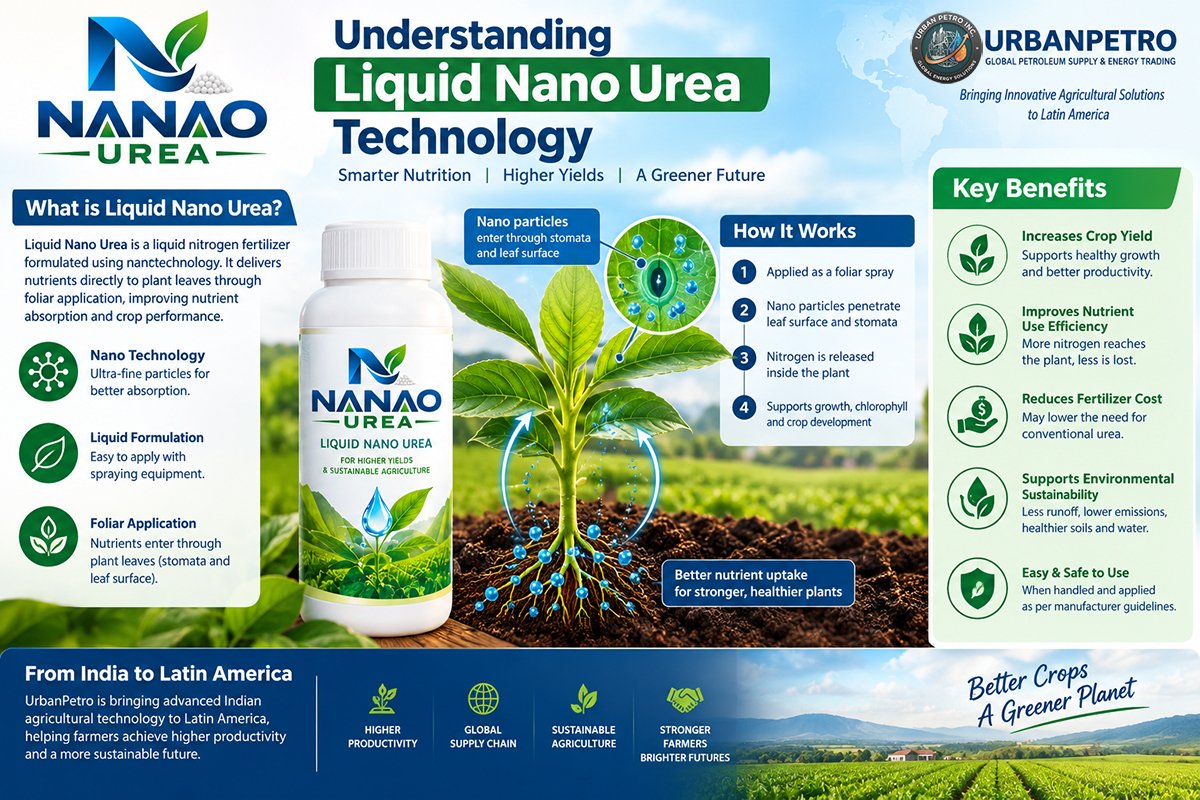
Developed within India’s expanding agricultural technology sector, Nano Urea is a liquid nitrogen fertilizer formulated using nanotechnology-based approaches. Depending on the specific product, it is designed to provide nitrogen through foliar application, allowing nutrients to be applied directly to plant leaves at particular stages of crop development.
Among the Indian organizations working in this field is Ray Nano Sciences and Research Centre, an agricultural technology company associated with the development of liquid Nano Urea and other nano-fertilizer formulations.
Indian government fertilizer notifications published in 2026 identify Ray Nano Sciences and Research Centre among the manufacturers of notified nano-fertilizer products. This provides an important regulatory reference point for evaluating the company’s technology and its potential commercial applications.
UrbanPetro is developing an international commercial approach to introduce Indian liquid Nano Urea technology and establish supply-chain opportunities for Latin American agricultural markets.
The objective is to connect agricultural technology with regional distributors, commercial farms, fertilizer importers, agricultural cooperatives and other qualified buyers interested in evaluating advanced crop-nutrition products.
The opportunity is significant, but responsible commercialization requires more than introducing a new fertilizer. It requires transparent product specifications, independent agricultural evaluation, regulatory compliance, reliable supply, appropriate application guidance and measurable economic benefits for farmers.
UrbanPetro’s proposed approach is therefore to connect the technology with international markets through a structured supply and market-development strategy, supported by product documentation and local agricultural validation.
2. Understanding Liquid Nano Urea Technology
Urea is a nitrogen-containing fertilizer used to support essential plant functions, including the development of leaves, stems, proteins and chlorophyll.
Conventional agricultural urea generally contains approximately 46% nitrogen by weight. It is commonly supplied in solid granular or prilled form and applied to soil, where the nitrogen becomes available to plants through soil processes.
Liquid Nano Urea follows a different delivery approach.
Instead of relying exclusively on soil application, a suitable liquid formulation is applied to plant foliage according to the manufacturer’s recommended dosage and crop-growth stage.
The formulation uses nanoscale material or nitrogen-containing components designed to improve nutrient delivery under appropriate conditions. The precise composition, nitrogen concentration, particle-size distribution and recommended application rate vary between manufacturers and products.
These differences are commercially important. The term “Nano Urea” does not describe one universal formulation with identical performance characteristics.
How foliar application works
Plant leaves contain microscopic openings called stomata, as well as other pathways through which certain dissolved substances can enter or interact with plant tissues.
A properly formulated foliar fertilizer is applied to the leaf surface, where nutrient uptake can occur under suitable environmental and physiological conditions.
The potential advantages of foliar nitrogen delivery include:
- Supplying additional nitrogen during selected stages of crop development.
- Supporting crop nutrition when foliar application is agronomically appropriate.
- Providing another option for managing nitrogen alongside conventional fertilizers.
- Potentially reducing the amount of conventional nitrogen fertilizer required in some crop-management systems.
- Allowing farmers to apply nutrients using suitable spraying equipment rather than relying exclusively on soil application.
The actual benefits depend on the formulation, crop species, soil fertility, weather, application timing, existing nitrogen supply and farming practices.
Nano Urea should not automatically be assumed to replace all conventional nitrogen fertilizer. Its role must be determined from product-specific recommendations and reliable field evidence.
3. Ray Nano Sciences and Research Centre: An Indian Agricultural Technology Organization
Ray Nano Sciences and Research Centre is associated with the development of nano-enabled agricultural inputs, including liquid Nano Urea, Nano DAP and other nutrient formulations.
An industry publication featuring the organization identifies its founder and CEO as Siddhartha Doshi and lists its location in Vitthal Udyognagar, Anand district, Gujarat, India.
The same publication identifies the organization’s areas of interest as including Nano Urea, Nano NPK, Nano DAP, micronutrients, biostimulants and other agricultural formulations. These details provide background on the company’s stated technology focus; current corporate information and product availability should be confirmed directly with the organization before a commercial agreement is concluded.
Regulatory recognition in India
India regulates fertilizer products under the Fertiliser (Inorganic, Organic or Mixed) Control Order, 1985, and related notifications.
In March 2026, the Indian government published a notification identifying multiple nano-fertilizer formulations and their associated technical specifications and manufacturers. The notification includes a Ray Nano Sciences and Research Centre liquid Nano Urea formulation specified at 16% total nitrogen by weight.
A separate Indian government notification published in April 2026 lists a Ray Nano liquid Nano Urea formulation with a minimum total nitrogen specification in the 1–5% range.
These are materially different specifications. Buyers must not assume that every Ray Nano product carries the same nitrogen concentration or that a single specification applies to every product currently offered by the company. The applicable notification, current product label, registration status and batch documentation must be reconciled before a specific formulation is advertised or imported.
For international buyers, this regulatory information is an important starting point. However, Indian authorization does not automatically establish authorization for sale or use in Bolivia, Brazil, Argentina, Paraguay, Peru, Chile or another destination country.
What international buyers should verify
Before placing a commercial order, UrbanPetro and prospective buyers should obtain and review the following documentation from the manufacturer or its authorized commercial representative:
- Current technical data sheet.
- Product label and complete nutrient composition.
- Applicable Indian manufacturing authorization and fertilizer notification.
- Product-specific registration or notification references.
- Certificate of Analysis for the relevant batch.
- Independent laboratory test results, where available.
- Particle-size characterization and associated analytical methods.
- Safety Data Sheet.
- Recommended application rates and crop-specific instructions.
- Shelf life, storage conditions and packaging specifications.
- Manufacturing capacity and documented export availability.
- Export documentation and destination-country regulatory requirements.
These documents allow buyers to evaluate the product on technical and commercial grounds rather than relying solely on promotional statements.
4. Why Latin America Represents an Important Market Opportunity
Latin America is one of the world’s important agricultural regions.
Its production systems include soybeans, maize, wheat, rice, sugarcane, cotton, coffee, fruits, vegetables and numerous other commercial crops. Agricultural performance depends on multiple factors, including nitrogen availability, soil conditions, rainfall, irrigation, crop varieties and farm-management practices.
Brazil and Argentina have major commercial crop sectors, while Bolivia, Paraguay, Peru and Chile have distinct agricultural production systems and fertilizer requirements.
For these markets, improved fertilizer management can have implications for farm profitability, nutrient stewardship and supply-chain resilience.
UrbanPetro’s proposed market-development strategy focuses on introducing Indian liquid Nano Urea technology to qualified agricultural buyers and developing commercial relationships with distributors and farming-sector organizations.
Potential market segments
Brazil: Large-scale soybean, maize, sugarcane and other crop-production systems may provide opportunities for properly validated foliar nutrient products.
Argentina: Commercial grain and oilseed producers may be interested in evaluating alternative nitrogen-management strategies alongside established fertilizer programs.
Bolivia: Agricultural cooperatives, distributors and commercial farms may provide opportunities to test suitable formulations under local soil, climate and crop conditions.
Paraguay: Soybean, maize and other agricultural sectors may offer potential distribution and field-evaluation opportunities.
Peru: Agricultural distributors and producers of selected commercial crops may be interested in crop-specific foliar nutrition solutions.
Chile: Horticulture, fruit production and other suitable agricultural applications may warrant product-specific evaluation.
These are potential target markets, not a claim that the product is already approved, registered or commercially available in each country.
The importance of local agricultural validation
A formulation that performs well under Indian agricultural conditions may not deliver identical results in Latin America.
Differences in climate, soil chemistry, crop varieties, humidity, rainfall, spray technology and farming practices can influence fertilizer performance.
For this reason, UrbanPetro’s market-development model should include local agronomic consultation, controlled demonstration plots, comparison against standard fertilizer programs and documented yield and cost measurements.
This approach can help establish whether the technology provides a meaningful benefit under the conditions faced by local farmers.
5. Nano Urea Compared With Conventional Granular Urea
One of the most important questions for agricultural buyers is whether liquid Nano Urea can reduce fertilizer costs without compromising crop yield.
The answer depends on how the products are used and which formulations are compared.
Conventional granular urea contains approximately 46% nitrogen by weight. A liquid Nano Urea product may contain a much lower nitrogen concentration but is designed for a different application method.
Therefore, comparing the price of one bottle with the price of one bag of granular urea is not a scientifically valid way to establish economic superiority.
A proper comparison must examine the complete fertilizer program, crop response, nitrogen requirements, application expenses and final economic return.
A. Nitrogen concentration
Conventional urea typically contains 46% nitrogen by weight.
Ray Nano’s 2026 regulatory notifications identify liquid formulations with different nitrogen specifications, including a 16% formulation and a separate formulation with a 1–5% minimum nitrogen specification.
The applicable product label and regulatory documentation must determine which specification is used for any commercial offer.
Nitrogen concentration alone does not establish how much nitrogen a crop can absorb or whether a fertilizer can replace another product.
B. Application method
Conventional granular urea is generally applied to soil.
Liquid Nano Urea is applied to foliage according to its product-specific instructions.
The two methods have different application requirements, equipment needs and nutrient-delivery pathways. Their performance should therefore be compared as complete crop-nutrition programs rather than as interchangeable products.
C. Potential fertilizer savings
Nano Urea may support a reduction in conventional nitrogen fertilizer use when it is incorporated into a scientifically appropriate nutrient-management program.
However, the magnitude of any reduction depends on the crop, formulation, application timing and experimental results.
Farmers should not reduce their recommended nitrogen application solely because a product is marketed as nano-enabled.
The objective is to maintain or improve crop performance while using nutrients more efficiently—not to maximize fertilizer reduction regardless of yield.
D. Transport and handling
Liquid formulations can provide practical advantages in certain distribution and application systems.
Potential considerations include the number of containers required, packaging weight, storage conditions, freight costs, spray equipment and application labor.
However, liquid fertilizer is not automatically cheaper to transport. The actual economics depend on the concentration of the product, packaging format, shipment size, route and the quantity required per hectare.
E. Farmer profitability
The most meaningful commercial comparison is the total cost of achieving a given crop yield and quality.
This includes:
- Conventional fertilizer costs.
- Nano-fertilizer costs.
- Freight, insurance and import expenses.
- Storage and handling.
- Application labor and equipment.
- Changes in crop yield and marketable quality.
- Any additional agronomic inputs required.
- The financial effect of yield variability or crop loss.
A product that costs less per application may not necessarily be more profitable if it reduces yield. Conversely, a higher-cost product may provide value if it demonstrably improves the complete production system.
The commercial objective should be lower cost per unit of marketable production, not simply lower fertilizer expenditure per hectare.
6. What Agricultural Research Actually Shows
The scientific evidence on Nano Urea includes promising results, but it also demonstrates why product-specific testing is essential.
Research findings should be considered carefully because different formulations, crops, application rates and experimental conditions can produce different outcomes.
Indian government research and field-trial information
The Indian Council of Agricultural Research and government fertilizer authorities have reported trials examining Nano Urea used as a foliar spray.
A 2023 government response described trials at 20 selected locations and crops. It reported that combining foliar Nano Urea with a recommended basal application of conventional urea showed a yield advantage of approximately 3–8% in the reported trials.
This finding concerns particular trial conditions and does not establish that all Nano Urea products will generate the same yield increase.
IFFCO has also published field-trial summaries for its own Nano Urea products. These reports describe crop responses when Nano Urea is used in conjunction with a reduced conventional fertilizer dose.
For example, an IFFCO summary of 205 trials across selected crops reports an average yield increase of approximately 5.28% for its Nano Urea Plus demonstration treatment compared with the stated farmer-practice treatment.
These results are specific to the product and trial conditions reported by IFFCO. They should not be transferred directly to Ray Nano formulations without independent supporting evidence.
Evidence supporting integrated nitrogen management
A 2026 agricultural study on wheat evaluated combinations of conventional nitrogen fertilizer and foliar Nano Urea.
The research found that certain treatments combining 75% of the recommended nitrogen dose with Nano Urea sprays achieved yields statistically comparable to a conventional treatment using the full recommended nitrogen dose.
The reported results support further investigation of integrated nutrient-management strategies, rather than assuming that liquid Nano Urea can universally replace soil-applied nitrogen.
A separate 2026 review of the research literature concluded that first-generation Nano Urea generally does not replace soil-applied urea on its own. The review identified moderate reductions in conventional nitrogen inputs, often around 20–25%, as a more defensible approach when Nano Urea is combined with adequate basal fertilization and appropriately timed foliar applications.
The review also cautioned that attempts to replace 50% or more of conventional urea frequently resulted in yield penalties or weaker nitrogen uptake.
Why these findings matter for UrbanPetro
The evidence suggests that Nano Urea is best evaluated as part of an integrated crop-nutrition program.
UrbanPetro should therefore avoid promising universal yield increases, guaranteed fertilizer savings or complete replacement of conventional urea.
Instead, commercial demonstrations should establish the following:
- Whether the specific Ray Nano formulation improves crop performance.
- Whether conventional nitrogen use can be reduced without a yield penalty.
- Whether fertilizer and application costs decrease.
- Whether crop quality and marketable yield are maintained.
- Whether the product performs consistently across relevant soil and climatic conditions.
These measurements can form the foundation of a credible international agricultural technology offering.
7. Environmental Considerations: Nitrogen Loss, Water Quality and Emissions
The environmental case for improving nitrogen management is well established.
When nitrogen fertilizer is applied in excess of crop demand, or when the timing and method of application are poorly matched to crop requirements, nitrogen can be lost through several pathways.
These include nitrate leaching, ammonia volatilization and emissions of nitrous oxide.
Nitrate movement into groundwater and surface water can contribute to water-quality problems. Nitrous oxide is a potent greenhouse gas, while ammonia emissions can contribute to air pollution and the formation of secondary particulate matter under suitable atmospheric conditions.
The extent of these effects depends on the fertilizer formulation, soil conditions, weather, crop uptake and agricultural management.
Potential benefits of improved nutrient management
A well-designed fertilizer program that supplies nitrogen more closely in line with crop demand can help reduce avoidable nutrient losses.
Foliar fertilization may provide an additional pathway for delivering nutrients during selected crop-growth stages.
When integrated with appropriate soil fertilization and crop management, such an approach may help improve nitrogen-use efficiency and reduce certain environmental losses.
However, environmental benefits should be demonstrated rather than assumed.
A liquid formulation does not automatically eliminate nitrate leaching, ammonia emissions or nitrous oxide emissions.
What field studies have reported
A published study examining Nano Urea in okra cultivation in coastal West Bengal reported lower nitrate concentrations in leachate and lower measured nitrous oxide emissions in certain Nano Urea treatments than in the conventional urea treatment.
The study also found lower crop yields in several treatments that relied heavily on Nano Urea as a substitute for conventional nitrogen fertilizer.
This is an important distinction: an environmental indicator can improve while crop productivity declines.
The appropriate goal is to identify a fertilizer program that balances environmental performance, crop yield and economic return.
Environmental assessment for Latin America
For commercial introduction into Latin America, environmental claims should be supported by relevant local or transferable evidence.
Potential indicators include:
- Nitrogen-use efficiency.
- Nitrate concentration in drainage water.
- Nitrous oxide emissions.
- Ammonia losses where relevant.
- Soil nitrogen status.
- Crop yield and nitrogen uptake.
- Total fertilizer use per hectare.
- Nutrient losses per unit of harvested production.
Such measurements can help determine whether a particular Nano Urea formulation provides a meaningful environmental advantage over a conventional fertilizer program.
UrbanPetro should not advertise a specific percentage reduction in pollution or greenhouse-gas emissions unless the claim is supported by appropriate studies for the relevant product and conditions.
8. Product Safety, Handling and Responsible Application
Product safety is essential when introducing any agricultural chemical or fertilizer to a new market.
Nano Urea should be handled according to the specific manufacturer’s Safety Data Sheet, product label and local regulatory requirements.
Safety procedures should reflect the actual formulation, its ingredients and its intended application method.
Storage
The product should be stored in its original, properly labelled container under the manufacturer’s specified temperature and storage conditions.
Containers should be kept securely closed when not in use and protected from contamination, incompatible materials and unauthorized access.
The manufacturer should specify any restrictions concerning freezing, excessive heat, direct sunlight or prolonged storage.
Personal protective equipment
Personnel handling or spraying the product should follow the product label and Safety Data Sheet.
Depending on the formulation and task, this may include appropriate protective gloves, protective clothing and eye protection.
Where spray mist may be generated, workers should follow the specified precautions for inhalation exposure and use appropriate protective equipment when required.
Mixing and spraying
The product should be diluted only according to the manufacturer’s instructions.
Farmers should not improvise application rates or mix the product with pesticides, other fertilizers or agricultural chemicals without confirmation of compatibility.
A small compatibility test may be appropriate where the label permits mixing, but it does not replace the manufacturer’s guidance.
Application should be undertaken with suitable equipment, taking account of wind conditions, worker exposure, nearby water bodies and the risk of spray drift.
Environmental protection
Spills should be managed in accordance with the Safety Data Sheet.
Uncontrolled discharge into drains, streams, ponds or other water bodies should be avoided.
Empty containers should be managed according to the product label and applicable waste regulations. They should not be reused for drinking water, food or household storage.
Worker training
Commercial distributors should provide appropriate product training before supplying the fertilizer to end users.
Training should cover dosage, dilution, crop-growth stage, spraying procedures, protective measures, storage and emergency response.
The manufacturer should provide the applicable safety documentation before shipment.
Important safety qualification: Nano-scale particle size alone does not establish that a product is either hazardous or harmless. Safety must be assessed for the actual formulation, exposure route, dose and intended use.
9. Commercial Economics: Can Nano Urea Be More Profitable?
Profitability is one of the most important questions for agricultural distributors and farmers.
The correct comparison should evaluate the entire production system rather than comparing the unit prices of two differently formulated fertilizers.
A useful calculation is:
Net economic benefit per hectare = additional crop revenue + fertilizer and application savings − additional product, freight and application costs − any loss in crop revenue.
The calculation should be conducted using actual quotations, documented application rates, local crop prices and measured trial results.
Illustrative comparison framework
Consider two hypothetical crop-management programs:
Program A: Conventional granular urea applied according to the local agronomic recommendation.
Program B: An appropriate basal nitrogen application combined with a specific liquid Nano Urea formulation and the manufacturer’s recommended foliar applications.
The farmer should compare the total cost of both programs and record their respective yields and crop quality.
The results may differ according to the crop, location, weather and formulation.
A successful Nano Urea program would demonstrate that its total economic return is competitive while maintaining acceptable crop productivity.
Potential sources of economic value
A validated program may offer value through one or more of the following:
- Reduced conventional fertilizer requirements.
- Lower costs associated with nitrogen application.
- Improved crop performance under suitable conditions.
- Better alignment of nutrient delivery with crop demand.
- Reduced losses of nitrogen that would otherwise be unavailable to the crop.
- Improved fertilizer logistics in particular distribution systems.
None of these benefits should be guaranteed before testing.
Commercial cost factors
For international supply, the landed cost should include:
- Manufacturer’s product price.
- Packaging and loading.
- Inland transport.
- Export documentation.
- International freight and insurance.
- Customs duties and import taxes.
- Local warehousing and distribution.
- Product registration and compliance expenses.
- Final delivery and application costs.
The commercial assessment should use a clearly stated Incoterm, delivery location, currency, order quantity and quotation validity period.
This allows importers and distributors to compare the product against conventional fertilizer alternatives on a consistent basis.
10. Bulk Supply and International Distribution Opportunities
UrbanPetro is developing a commercial approach for introducing Indian liquid Nano Urea technology into Latin American and other international markets.
For agricultural buyers, the principal considerations are not only the formulation itself but also the manufacturer’s ability to provide consistent quality, reliable documentation and a dependable supply schedule.
Product information for commercial evaluation
| Item | Information |
| Product category | Liquid Nano Urea nitrogen fertilizer |
| Technology origin | India |
| Manufacturer identified in Indian government notifications | Ray Nano Sciences and Research Centre |
| Product formulation | To be confirmed against the current manufacturer label and applicable notification |
| Nitrogen concentration | Product-specific; obtain current certified specification |
| Physical form | Liquid |
| Intended application | Foliar application where permitted by the label |
| Crop suitability | To be established using product instructions and local agronomic recommendations |
| Packaging | To be confirmed with the manufacturer |
| Bulk supply | Subject to written confirmation of available production and export capacity |
| Export markets | Subject to destination-country registration and import requirements |
| Quality documentation | Current technical data sheet, Safety Data Sheet and batch Certificate of Analysis |
| Pricing | Formal quotation required |
| Delivery terms | To be agreed with the supplier and buyer |
| Shelf life | To be confirmed by the manufacturer |
| Country-specific approval | Must be verified before commercial sale or use |
Important clarification on available quantity
UrbanPetro intends to develop bulk commercial supply opportunities. However, no independently verified production-capacity figure, current export inventory or confirmed monthly allocation for Ray Nano Sciences and Research Centre has been established in this article.
Accordingly, a specific quantity must not be advertised as immediately available stock until the manufacturer or authorized supplier confirms it in writing.
For qualified buyers, the commercial process should establish:
- Required quantity per shipment.
- Estimated monthly or annual demand.
- Destination country and delivery location.
- Packaging and palletization requirements.
- Product specification and nitrogen concentration.
- Required registration and import documentation.
- Delivery schedule.
- Price, currency and payment terms.
- Inspection and quality-assurance requirements.
- Whether the supply is available directly from the manufacturer or through an authorized commercial arrangement.
This information will allow UrbanPetro to evaluate the feasibility of individual orders and develop a transparent international supply chain.
11. UrbanPetro’s Role in Bringing Indian Agricultural Technology to Latin America
UrbanPetro’s proposed initiative is designed to connect agricultural technology from India with buyers and distribution opportunities in Latin America.
The company’s market-development objective is to establish commercial relationships that support product evaluation, regulatory compliance, supply planning and regional distribution.
The strategy can be developed through several stages.
Stage One: Manufacturer and product verification
UrbanPetro should obtain written confirmation of the manufacturer, applicable product specification, regulatory status, available supply quantity and export authorization.
This stage should also establish whether the product can be exported directly and what commercial authorization, if any, is required for UrbanPetro’s role.
Stage Two: Destination-market assessment
Each prospective destination country should be assessed individually.
The review should cover fertilizer registration, importer eligibility, product labelling, technical documentation, customs classification and any applicable environmental or agricultural requirements.
Local agronomists and qualified import specialists should be involved where appropriate.
Stage Three: Agricultural demonstration
Where legally permitted, controlled field demonstrations can compare the product with conventional nitrogen-management practices.
The trials should use suitable experimental design, documented application rates and measurable outcomes.
Results should be recorded transparently, including any cases where the product does not improve yield or reduce costs.
Stage Four: Commercial distribution
After the required regulatory and technical checks, UrbanPetro can evaluate commercial arrangements with eligible distributors, agricultural cooperatives, importers and other qualified buyers.
Commercial terms should be established in writing, with clear responsibilities for product quality, registration, transport, storage, technical support and customer service.
Stage Five: Regional supply-chain development
If the technology demonstrates commercial value and the relevant approvals are obtained, the model may be expanded to additional markets.
This could involve distributor networks, agricultural demonstrations, demand forecasting and coordinated international supply.
The long-term objective is to build a commercially viable route for appropriate Indian agricultural inputs to reach Latin American customers.
12. Challenges and Considerations Before Large-Scale Adoption
Despite the potential of Nano Urea, several issues require attention before large-scale commercial adoption.
Scientific validation
Results from one manufacturer or crop cannot automatically be applied to another formulation or agricultural environment.
Independent product-specific trials are needed to determine performance under relevant local conditions.
Crop-specific nitrogen requirements
Nitrogen requirements vary substantially across crops and growth stages.
Some crops require significant nitrogen availability in the soil during early development. Foliar fertilizer alone may not provide enough nitrogen to satisfy total crop demand.
Regulatory requirements
A product authorized in India may require a separate registration, notification or authorization before import, distribution or use in another country.
Importers should obtain local regulatory advice before making commercial commitments.
Farmer education
Incorrect application rates, inappropriate timing or unsuitable mixing practices may reduce effectiveness or damage crops.
Training and accurate product instructions are essential.
Product quality and consistency
Bulk buyers require reliable specifications and consistent quality from batch to batch.
Certificates of Analysis, traceability, shelf-life information and appropriate quality controls should be part of the commercial documentation.
Honest environmental marketing
Claims about pollution reduction, carbon benefits or soil-health improvements should be supported by appropriate evidence.
A credible agricultural technology program must disclose both its advantages and its limitations.
13. A Strategic Opportunity for Indian Agricultural Innovation
India’s development of nano-enabled fertilizer products reflects an effort to explore new methods of nutrient delivery and improve fertilizer management.
Ray Nano Sciences and Research Centre is one of the organizations identified in India’s fertilizer regulatory framework in connection with liquid Nano Urea and related formulations.
The next stage for international market development is to establish which formulations deliver practical agronomic and economic benefits in specific agricultural environments.
For Latin American markets, the opportunity is not simply to import a new fertilizer. It is to evaluate whether a particular technology can help farmers manage nitrogen more effectively while maintaining productivity and protecting environmental resources.
UrbanPetro’s proposed role is to support the commercial connection between Indian technology and Latin American agricultural demand through manufacturer engagement, product verification, regulatory assessment and supply-chain development.
This approach can help qualified buyers evaluate the product on its technical merits while giving farmers and distributors a clearer understanding of its potential uses.
14. Conclusion: From Indian Agricultural Technology to International Market Development
Liquid Nano Urea has attracted attention as a potential component of more targeted nitrogen management.
Research indicates that certain Nano Urea formulations can complement conventional fertilizers and may support reductions in conventional nitrogen use under suitable conditions. However, results are not uniform across products and crops, and the evidence does not justify treating every Nano Urea formulation as a complete replacement for conventional urea.
Ray Nano Sciences and Research Centre’s inclusion in Indian fertilizer notifications provides a regulatory reference for further product evaluation. International buyers must still verify the exact formulation, current product documentation, supply capacity and destination-country authorization.
UrbanPetro is developing an initiative to connect Indian liquid Nano Urea technology with Latin American agricultural markets.
The initiative’s success will depend on transparent product information, credible field trials, verified supply arrangements, appropriate safety procedures and demonstrable economic value.
The future of agricultural innovation will be determined not by promotional claims alone, but by whether technologies provide measurable benefits to farmers, distributors and the wider agricultural economy.
UrbanPetro Global News will continue to examine developments in agricultural technology, fertilizer innovation and international supply-chain opportunities as the sector evolves.
ABOUT URBANPETRO
UrbanPetro is developing international commercial opportunities across energy, commodities and agricultural supply chains. Its proposed Nano Urea market-development initiative focuses on connecting Indian agricultural technology with qualified buyers and distribution opportunities in Latin America.
The company’s commercial participation, supply arrangements and authorization for any particular product should be established through the relevant written agreements and product documentation.

EDITORIAL AND TECHNICAL DISCLAIMER
UrbanPetro Global News Desk
Chief Editor: Mr. Baiju Jayachandran
Website: www.urbanpetro.com
This article is an industry-information feature and is not a substitute for product-specific agronomic advice, independent laboratory analysis or regulatory approval.
Product specifications, nitrogen concentrations, manufacturing capacity, current inventory, pricing and export availability must be confirmed with the manufacturer or authorized supplier before publication in a binding commercial offer.
No claim is made that liquid Nano Urea universally replaces conventional granular urea, guarantees increased crop yields, ensures lower production costs or eliminates environmental pollution.
All commercial activities must comply with the laws and fertilizer registration requirements applicable in the country of import and use.