
EDITOR’S NOTE & EXECUTIVE SUMMARY
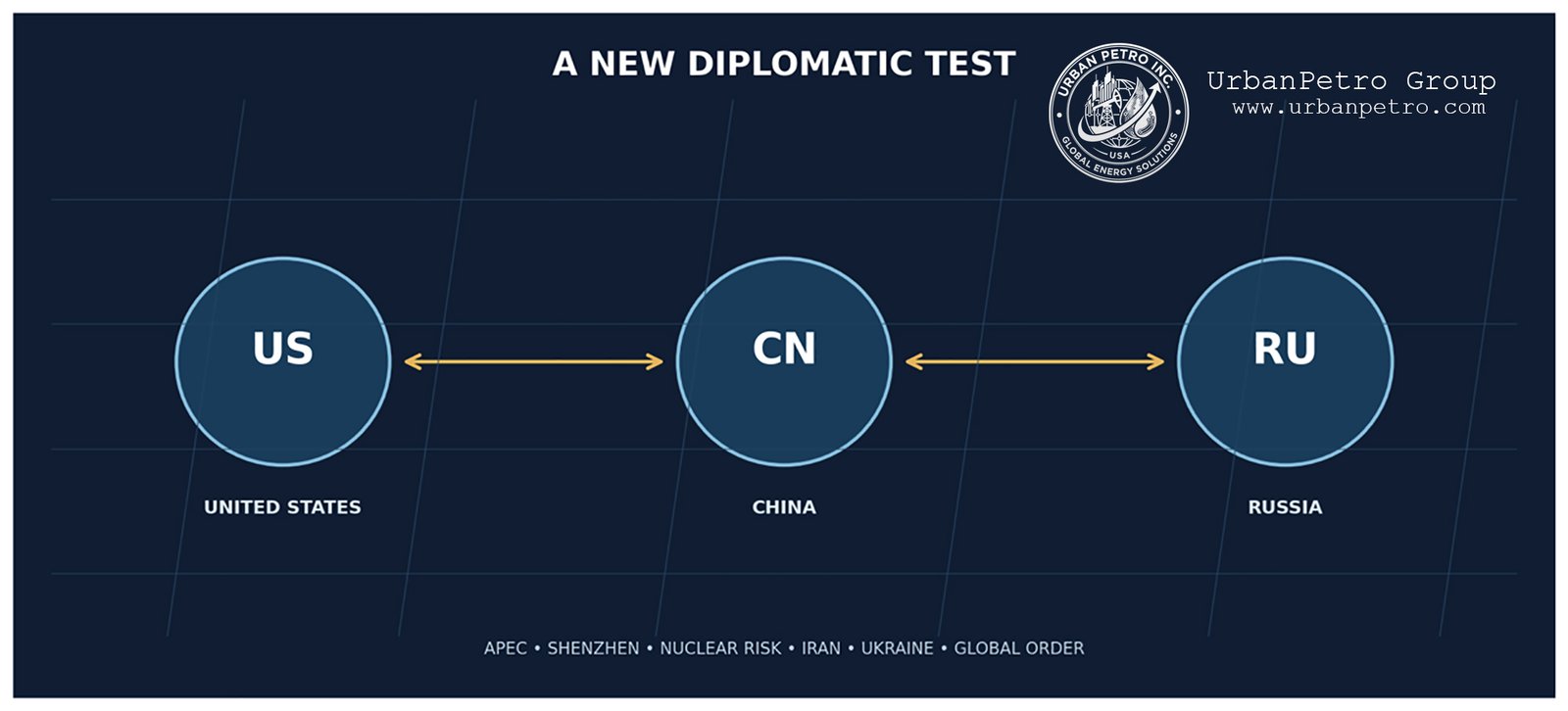
A proposed meeting among the leaders of the United States, China and Russia is emerging as one of the most consequential diplomatic developments on the international calendar. The White House has confirmed that U.S. President Donald Trump plans to meet Chinese President Xi Jinping and Russian President Vladimir Putin on the sidelines of the Asia-Pacific Economic Cooperation (APEC) summit in Shenzhen, China, on 19 November 2026. The announcement places nuclear arms control and the war involving Iran at the centre of attention, while U.S. officials have indicated that the war in Ukraine is not expected to be part of the trilateral discussion.
The meeting is historic in format, but expectations for an immediate agreement remain restrained. Washington has described the nuclear discussion as an opening conversation rather than a negotiation expected to produce a signed deal. Beijing has previously resisted joining trilateral nuclear-arms negotiations, arguing that its arsenal is substantially smaller than those of the United States and Russia. Moscow, meanwhile, may see the meeting as an opportunity to reinforce its status as a major global power.
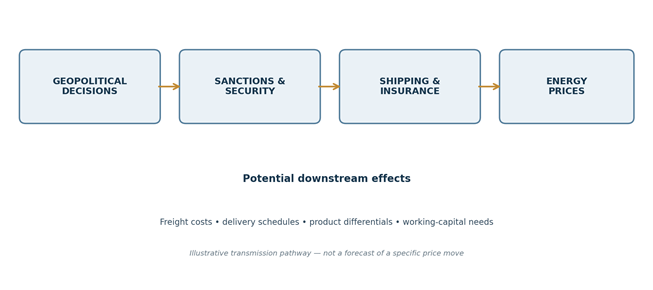
For governments, businesses and commodity markets, the significance extends beyond the summit room. The Iran conflict, the security of Gulf energy routes, the war in Ukraine, sanctions policy and U.S.–China trade competition all affect international confidence, shipping, insurance, energy availability and investment decisions. These are potential transmission channels, not proof that any particular price or supply outcome will occur.
Key points at a glance
- The White House says Trump, Xi and Putin are expected to meet on 19 November in Shenzhen during the APEC summit.
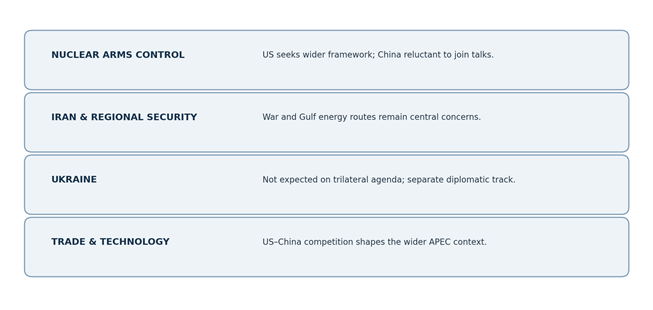
- Nuclear arms reduction is expected to be a central topic; U.S. officials have cautioned that no agreement is expected at this stage.
- The expired New START treaty has left the United States and Russia without the previous treaty’s binding limits on their strategic nuclear arsenals.
- The leaders are expected to discuss the Iran war and its wider implications.
- Ukraine is not expected to be raised in the trilateral session; separate diplomatic contacts continue.
- ASEAN leaders are also preparing discussions on regional conflicts, the South China Sea, Myanmar and international law.
1. THE SHENZHEN SUMMIT: THREE POWERS, DIFFERENT OBJECTIVES
The planned trilateral meeting is scheduled for the margins of APEC in Shenzhen, a major technology and manufacturing centre in southern China. The gathering brings together leaders whose countries possess the world’s largest nuclear arsenals and whose decisions shape security, trade and diplomacy across multiple regions. The White House confirmation, reported by Reuters and the Associated Press on 13–14 November, makes the proposed session a major diplomatic event.
The symbolism is considerable: three leaders with competing strategic interests will appear in a single diplomatic format. Yet the policy objectives are not identical. Washington wants to explore a broader arms-control framework that includes China. Beijing has been reluctant to enter negotiations designed around the much larger U.S. and Russian arsenals. Moscow may seek strategic recognition and opportunities to influence the wider security conversation.
What each government may seek
| UNITED STATES | CHINA | RUSSIA |
| Promote a future arms-control framework involving all three powers; raise Iran and demonstrate diplomatic leadership. | Avoid being drawn into limits that it considers disproportionate; protect strategic autonomy and discuss regional stability and Iran. | Reinforce its great-power status, shape the arms-control debate and seek diplomatic leverage while preserving its positions on Ukraine. |
2. NUCLEAR ARMS CONTROL: THE CENTRAL STRATEGIC QUESTION
The last remaining bilateral treaty placing verifiable limits on U.S. and Russian strategic nuclear forces, the New Strategic Arms Reduction Treaty (New START), expired in February 2026. Its expiry removed the treaty’s existing constraints and inspection framework at a time when strategic mistrust remains high. The proposed Shenzhen discussion therefore takes place against a weakened arms-control architecture.
President Trump has said he wants a new, modernised arrangement that includes China. The difficulty is structural: the U.S. and Russian arsenals are substantially larger than China’s, and Beijing has argued that it is not appropriate to join negotiations on equal terms with the two countries that hold much larger stockpiles. Reuters reported that a senior U.S. official did not expect an agreement at the meeting, describing it instead as the beginning of a conversation.
The immediate test will be whether the leaders can agree on a process for continued dialogue: technical consultations, transparency measures, risk-reduction communications or a future negotiating framework. Even a limited commitment to keep talking could matter; failure to establish a process would leave uncertainty elevated. No specific agreement should be assumed before the meeting takes place.
Why it matters internationally
A weaker arms-control framework can increase uncertainty about strategic intentions, force planning and crisis management. It can also complicate diplomacy among allies and rival powers. For businesses, the principal effect is indirect: elevated geopolitical risk can influence investment confidence, currency volatility, insurance pricing and government spending priorities.
3. IRAN AND THE MIDDLE EAST: A REGIONAL CONFLICT WITH GLOBAL CONSEQUENCES
The White House has indicated that the Iran conflict will be discussed by the three leaders. The conflict has become a major international concern because it involves military escalation, regional security and the movement of energy and other essential goods. China has a direct interest in stability because it is a major energy importer and has relied on Gulf routes for a significant share of its crude oil supply.
Russia’s position is shaped by its strategic relationship with Iran and by the broader effects of sanctions, energy-market disruption and diplomatic realignment. The United States, meanwhile, faces the challenge of managing military objectives, regional partnerships and the economic consequences of prolonged instability. The summit may provide an opportunity to communicate positions, but a three-way meeting alone cannot resolve the underlying conflict.
The Strait of Hormuz and energy security
The Strait of Hormuz is one of the world’s most important maritime energy chokepoints. Disruption or heightened security risks in the waterway can affect tanker routing, voyage times, freight rates, marine insurance, delivery schedules and the risk premium embedded in energy prices. The impact depends on the duration and severity of any disruption, available alternative routes, inventories, producer responses and market expectations.
For petroleum buyers and sellers, the practical priority is to distinguish confirmed operational disruption from market speculation. Contracting parties should verify vessel position, loading status, route advisories, insurance terms, port conditions, documentary status and delivery windows through appropriate counterparties and independent maritime sources.
4. UKRAINE: A SEPARATE DIPLOMATIC TRACK
U.S. officials have indicated that the Ukraine war is not expected to be discussed at the trilateral meeting. Washington’s stated reasoning is that Ukraine diplomacy is being handled through a separate track involving the parties directly engaged in those discussions. This distinction is important: the absence of Ukraine from the summit agenda does not mean the conflict is resolved or that diplomatic activity has stopped.
On 14 November, the Associated Press reported that Ukrainian President Volodymyr Zelenskyy warned that a U.S.-floated European security framework could benefit Russian President Vladimir Putin by weakening NATO or changing borders. Zelenskyy said Ukraine would not surrender territory or accept neutrality and that any proposal would be put to Ukrainian citizens. He also described priorities including an energy ceasefire, reopening the Black Sea, prisoner exchanges and a leaders’ meeting.
The gap between the positions of Kyiv, Moscow, Washington and European governments remains a central obstacle. Any durable settlement would require credible security arrangements, decisions on territory, monitoring and enforcement, reconstruction, sanctions and the participation of Ukraine itself. The proposed trilateral meeting is not a substitute for those negotiations.
5. U.S.–CHINA COMPETITION: TRADE, TECHNOLOGY AND STRATEGIC TRUST
The APEC setting places the meeting within a wider regional conversation about trade and economic integration. U.S.–China relations remain shaped by tariffs, technology restrictions, competition over advanced semiconductors and artificial intelligence, and China’s role in critical mineral supply chains. Even when leaders seek to stabilise relations, these structural issues remain difficult to separate from security policy.
For international companies, policy uncertainty can affect sourcing decisions, export controls, investment approvals, payment channels and compliance obligations. Companies operating across borders should monitor official announcements rather than assume that a diplomatic meeting will immediately change tariffs, sanctions or licensing rules.
6. ASEAN AND THE WIDER ASIAN DIPLOMATIC PICTURE
The Associated Press reported on 14 November that Southeast Asian leaders are preparing to meet in Manila for a three-day ASEAN summit. The agenda includes peaceful resolution of disputes in the South China Sea, Myanmar’s civil conflict, and wars in the Middle East and Ukraine. Draft language is reported to reaffirm international law, freedom of navigation and overflight, humanitarian access and inclusive dialogue.
The regional context matters because Southeast Asia is a major centre for shipping, manufacturing, energy demand and global trade. Tensions in the South China Sea or instability in Myanmar can affect regional confidence and supply-chain planning. ASEAN’s ability to maintain dialogue among members and external powers will remain important, although major breakthroughs should not be presumed.
7. WHAT THIS MEANS FOR GLOBAL ENERGY AND COMMODITY MARKETS
The geopolitical developments described in this report create several risk channels for international energy trade. They do not, by themselves, establish a direction for crude or refined-product prices. Market outcomes will depend on actual supply and demand, inventory data, production decisions, sanctions enforcement, shipping conditions, currency movements and the duration of geopolitical events.
- Crude oil and refined products: geopolitical risk may add volatility to benchmark prices and regional product differentials.
- Diesel and gasoil: refinery availability, export restrictions, freight and regional inventory levels can be as important as crude benchmarks.
- Jet fuel: aviation demand, refinery yields, airport supply and regional logistics determine local market tightness.
- LNG and LPG: shipping availability, contract flexibility and competition for cargoes can transmit regional disruption into global markets.
- Freight and insurance: heightened maritime risk can increase voyage costs and complicate delivery commitments.
- Trade finance and compliance: sanctions screening, vessel checks, beneficial ownership verification and documentary controls become more important during periods of tension.
8. SCENARIO WATCH: THE NEXT 7–14 DAYS
| SCENARIO | WHAT TO WATCH | POTENTIAL IMPLICATION |
| Diplomatic opening | Leaders agree to continue nuclear-risk and Iran-related dialogue. | Could reduce uncertainty at the margin; concrete policy changes would still require follow-through. |
| No substantive progress | Meeting produces statements but no shared process or commitments. | Geopolitical risk remains elevated; markets continue to react to events and operational data. |
| Further regional escalation | Military incidents or maritime disruption intensify around the Gulf. | Potential pressure on freight, insurance, delivery schedules and energy-price volatility. |
| Separate Ukraine diplomacy advances | Progress on exchanges, energy ceasefire or security guarantees. | Could improve regional sentiment, but a durable settlement would remain complex. |
9. URBANPETRO GLOBAL NEWS DESK: EDITORIAL ASSESSMENT
UrbanPetro’s assessment is that the proposed Shenzhen meeting should be watched as a strategic signal rather than treated as a guaranteed turning point. The most important indicators will be whether the three governments establish a continuing nuclear-risk dialogue, whether the Iran conflict is addressed through practical de-escalation channels, and whether maritime energy routes remain safe and commercially accessible.
For participants in international petroleum and commodity markets, disciplined verification is essential. Avoid basing commercial decisions solely on political headlines. Confirm physical availability, title and authority to sell, product specifications, origin, vessel and terminal details, sanctions status, insurance coverage, delivery terms and payment arrangements through independent due diligence and appropriate legal and banking channels.
Key indicators to monitor
- Official White House, Chinese Foreign Ministry and Kremlin statements before and after 19 November.
- Any published agenda, joint statement or follow-up mechanism on nuclear arms control.
- Developments affecting the Strait of Hormuz, Gulf shipping advisories and marine insurance.
- Verified announcements concerning Iran, regional ceasefire efforts and diplomatic mediation.
- Ukraine-related negotiations, Black Sea shipping and energy infrastructure developments.
- ASEAN communiqués on maritime security, Myanmar and freedom of navigation.
EDITORIAL CONCLUSION
The coming week places diplomacy, nuclear security and energy geopolitics in unusually close focus. The proposed meeting of the United States, China and Russia is historic in format, but its practical value will be measured by what follows: sustained communication, risk reduction and credible diplomatic processes. At the same time, the Iran conflict, Ukraine war and U.S.–China economic competition will continue to shape the international environment.
For the global energy industry, the message is clear: geopolitical developments must be assessed alongside physical supply, shipping, insurance, inventories and regulatory requirements. In a market where a political statement can move expectations before it changes actual barrels or cargoes, verified information and careful risk management remain indispensable.
— UrbanPetro Global News Desk