URBANPETRO GLOBAL ENERGY SPECIAL REPORT
NOVEMBER 1, 2026
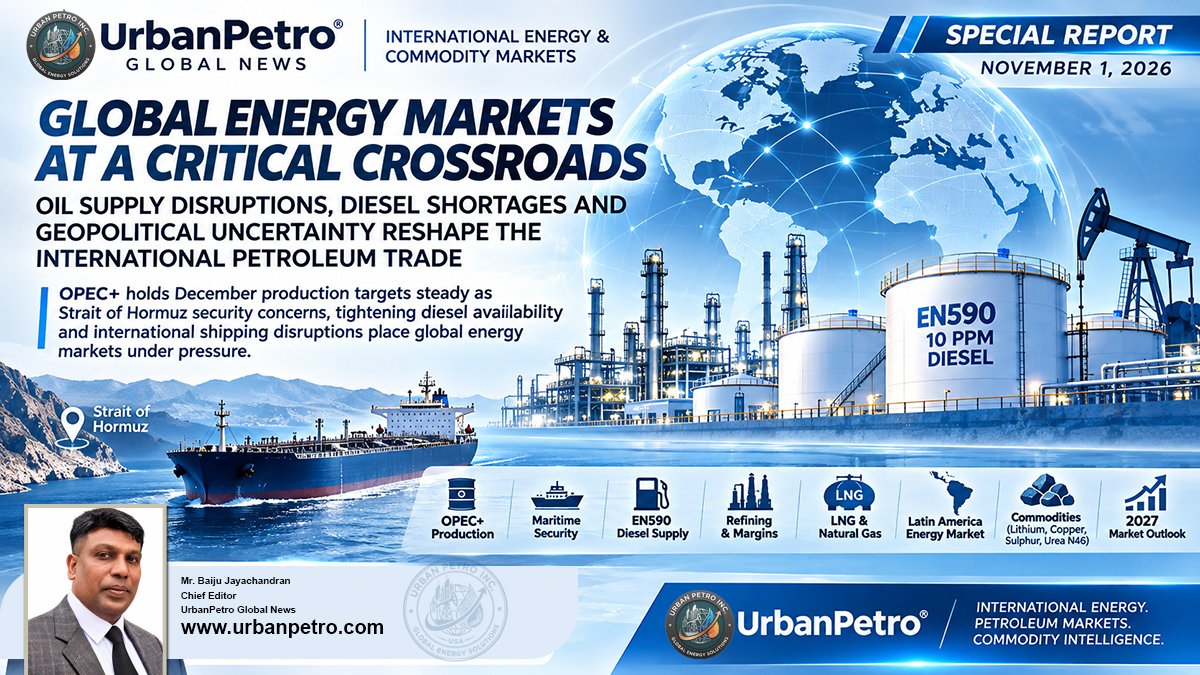
GLOBAL ENERGY MARKETS AT A CRITICAL CROSSROADS: OIL SUPPLY DISRUPTIONS, DIESEL SHORTAGES AND GEOPOLITICAL UNCERTAINTY RESHAPE THE INTERNATIONAL PETROLEUM TRADE
OPEC+ holds December production targets steady as Strait of Hormuz security concerns, tightening diesel availability and international shipping disruptions place global energy markets under pressure.
SPECIAL FEATURE | INTERNATIONAL ENERGY & COMMODITY MARKETS
Special Feature Editor: Mr. Baiju Jayachandran
Founder & CEO | UrbanPetro Inc.
Publication: UrbanPetro Global News
Date: Sunday, November 1, 2026
Coverage: Global | Middle East | Asia | Europe | Africa | Latin America
EXECUTIVE OVERVIEW: A NEW CHAPTER IN GLOBAL ENERGY TRADE
The international petroleum industry is entering another challenging period as geopolitical tensions, constrained energy transportation routes, refinery economics and changing global supply patterns reshape the international oil and refined petroleum products markets.
As November 2026 begins, energy markets are closely monitoring developments in the Middle East, particularly the security situation surrounding the Strait of Hormuz, one of the world’s most strategically important maritime energy transportation corridors.
The latest decision by seven key OPEC+ producers to maintain their December 2026 production targets at existing levels adds another important dimension to the global petroleum outlook.
At the same time, the International Energy Agency’s October Oil Market Report highlights significant pressure in global middle-distillate markets, particularly diesel and gasoil. International supply disruptions, declining inventories and elevated transportation costs have created challenging conditions for refiners, distributors, importers and industrial fuel consumers.
For international petroleum trading companies, these developments are more than market headlines. They represent important changes in the economics of sourcing, transportation, storage, procurement and long-term supply agreements.
From EN590 10 PPM diesel and automotive fuels to crude oil, jet fuel, LPG, LNG and other industrial commodities, the international energy market is increasingly dependent on reliable supply chains, transparent commercial structures and dependable logistics.
UrbanPetro examines the major developments shaping the global energy industry and their potential implications for international petroleum buyers, suppliers and commodity traders.
OPEC+ DECISION: GLOBAL OIL PRODUCTION STRATEGY ENTERS A NEW PHASE
The latest OPEC+ decision is attracting significant attention from international energy markets.
On November 1, seven key participating countries — Saudi Arabia, Russia, Iraq, Kuwait, Algeria, Kazakhstan and Oman — maintained their December oil production targets unchanged.
The decision comes at a time when geopolitical uncertainty and disruptions to international petroleum transportation continue to complicate global supply expectations.
According to reporting by Reuters, the participating producers have deferred further policy decisions until 2027, while the wider OPEC+ group is expected to meet on November 29 to consider its production framework for the coming year.
The situation creates an important question for international energy markets:
Will global oil production recover sufficiently in 2027 to restore market stability, or will geopolitical uncertainty continue to restrict supply?
Production targets do not necessarily represent actual production. Export infrastructure, transportation availability, refinery requirements and geopolitical conditions can prevent producers from reaching their allocated volumes.
For international buyers, understanding the difference between announced production targets and physically available export volumes is essential.
The coming weeks will therefore be important for crude oil procurement strategies and refined petroleum product pricing.
STRAIT OF HORMUZ: THE STRATEGIC ENERGY CORRIDOR UNDER INTERNATIONAL ATTENTION
The Strait of Hormuz remains one of the most important strategic transportation routes in the global petroleum industry.
Connecting the Persian Gulf with the Gulf of Oman and the Arabian Sea, this narrow maritime passage is essential to international crude oil, refined petroleum and LNG transportation.
The latest maritime security developments have increased concerns among shipping operators, insurance companies, energy producers and international commodity traders.
Reuters reported on October 30 that a tanker was struck by limpet mines in the Strait of Hormuz, causing an engine-room fire. The crew were reported safe, and the fire was extinguished.
The incident demonstrates the potential vulnerability of commercial shipping in strategically important maritime corridors.
For the international petroleum industry, maritime security affects much more than the movement of crude oil.
It influences:
- Tanker availability.
- Marine insurance premiums.
- Freight rates.
- Delivery schedules.
- Refinery procurement costs.
- CIF petroleum contract economics.
- Importers’ inventory strategies.
- Overall international fuel prices.
The consequences can extend far beyond the Middle East.
European, African, Asian and Latin American importers may experience indirect effects through changes in international benchmark prices, tanker availability and delivered petroleum costs.
UrbanPetro Perspective
International petroleum buyers should evaluate the complete delivered cost of fuel rather than considering the quoted product price alone.
A commercially attractive petroleum offer must also account for shipping routes, vessel availability, insurance, terminal compatibility, delivery windows and contractual responsibilities.
In an uncertain maritime environment, dependable logistics are an essential component of successful international petroleum trading.
GLOBAL DIESEL MARKET: EN590 10 PPM SUPPLY BECOMES A STRATEGIC PRIORITY
One of the most important developments for international petroleum traders is the continuing pressure on global diesel availability.
Diesel is an essential energy product supporting international transportation, commercial logistics, agriculture, mining, manufacturing, construction, power generation and industrial operations.
The International Energy Agency’s October 2026 Oil Market Report identifies significant constraints in global gasoil and diesel markets.
Its assessment highlights several important developments:
- Global diesel exports in September were approximately 700,000 barrels per day lower year-on-year.
- Russian and Middle Eastern supply disruptions reduced available export volumes.
- Global diesel inventories experienced substantial pressure.
- Refinery maintenance and transportation costs complicated market replenishment.
- Diesel supply constraints are expected to remain a concern into 2027.
The IEA also indicates that diesel market balances could remain tight well into 2027, depending on the recovery of international product supplies.
These developments have important implications for EN590 10 PPM diesel, a widely traded low-sulphur automotive diesel specification.
Why EN590 10 PPM matters
EN590 10 PPM diesel is a European automotive diesel specification with a maximum sulphur content of 10 milligrams per kilogram.
It is widely used as a benchmark specification in international petroleum trading, subject to the applicable destination-country standards and contractual requirements.
Its commercial importance comes from its low sulphur content and compatibility with modern diesel fuel requirements.
Key EN590 specification parameters
| Parameter | EN590 requirement |
| Sulphur content | Maximum 10 mg/kg |
| Cetane number | Minimum 51 |
| Cetane index | Minimum 46 |
| Density at 15°C | 820–845 kg/m³ |
| Flash point | Minimum 55°C |
| Polycyclic aromatic hydrocarbons | Maximum 8% m/m |
| FAME content | Maximum 7% v/v |
| Distillation, 95% recovered | Maximum 360°C |
Final product acceptance must follow the applicable EN590 edition, destination-country regulations and agreed contractual laboratory testing procedures.
International procurement outlook
As diesel markets experience supply pressure, international buyers increasingly need to evaluate:
- Verified refinery or authorised supplier sources.
- Product availability and export allocation.
- Independent inspection and laboratory certification.
- Vessel and terminal compatibility.
- Secure contractual payment arrangements.
- Reliable delivery schedules.
- Destination-country import requirements.
For buyers purchasing substantial volumes, supply continuity and contractual performance are as important as the initial quoted price.
GLOBAL REFINING INDUSTRY: CAPACITY, MARGINS AND SUPPLY CHALLENGES
The international refining industry is facing a complicated operating environment.
Refineries must balance crude oil procurement costs, processing expenses, energy consumption, maintenance schedules, transportation charges and the market value of finished petroleum products.
Diesel, gasoline, jet fuel and other refined products do not necessarily follow crude oil prices in a direct or proportional manner.
Refining margins can increase or decrease depending on product availability, regional demand, refinery utilisation and transportation costs.
The IEA’s October report identifies significant pressure on global refinery operations during 2026, alongside expectations for higher refinery throughput in 2027.
However, increased processing capacity alone does not guarantee an immediate recovery in international diesel exports.
The availability of suitable crude feedstock, refinery operational conditions, export infrastructure and regional consumption patterns will all influence the recovery.
What this means for petroleum buyers
International buyers should distinguish between:
- Crude oil availability.
- Refinery processing capacity.
- Actual refined product production.
- Exportable product volumes.
- Confirmed cargo allocations.
- Physically deliverable petroleum stocks.
A refinery’s theoretical production capacity is not equivalent to a confirmed export allocation.
This distinction is particularly important when negotiating large-volume EN590, Jet A1 and gasoline supply contracts.
INTERNATIONAL PETROLEUM SHIPPING: FREIGHT AND INSURANCE BECOME KEY COMMERCIAL FACTORS
The international petroleum trade depends on a complex network of shipping companies, tanker operators, ports, storage terminals, inspection companies, insurers and logistics providers.
When major maritime corridors experience disruption, the consequences can spread across the entire petroleum supply chain.
Higher freight costs can significantly affect the final CIF price of petroleum products.
For example, a cargo sourced from one geographical region may become less commercially competitive if vessel availability declines or the voyage requires a longer alternative route.
Key factors affecting international petroleum transportation
Tanker availability
The availability of suitable vessels is essential for transporting crude oil, diesel, gasoline, jet fuel and other liquid petroleum products.
Marine insurance
Higher geopolitical risks can influence insurance premiums and the conditions under which vessels operate.
Port infrastructure
Loading and discharge terminals must have the appropriate infrastructure, draft capacity, storage arrangements and product-handling facilities.
Shipping documentation
Bills of lading, certificates of origin, quality certificates, quantity certificates and other contractual shipping documents must be properly coordinated.
CIF commercial responsibilities
Under CIF Incoterms 2020, the seller arranges and pays for carriage and insurance to the named destination port, while risk generally transfers to the buyer when the goods are loaded on board the vessel at the port of shipment.
Understanding this distinction is essential when negotiating international petroleum supply agreements.
LATIN AMERICA: AN IMPORTANT REGION FOR FUTURE ENERGY TRADE
Latin America is increasingly important in discussions about international energy security, petroleum imports, mineral resources and industrial development.
The region combines major petroleum-producing countries, significant mineral reserves, growing energy consumption and strategic maritime infrastructure.
Brazil, Argentina, Bolivia, Chile, Peru and other regional markets offer different opportunities for international energy companies.
Brazil: A major petroleum and fuel market
Brazil remains one of the most important energy markets in South America.
Its petroleum industry includes domestic production, refining, fuel distribution, maritime imports and international exports.
The country also has substantial requirements for diesel to support agriculture, mining, commercial transportation and industrial activities.
For international petroleum suppliers, Brazil’s import requirements, regional refinery capacity and port infrastructure are important factors when assessing potential business opportunities.
Argentina: Expanding oil and gas production
Argentina’s Vaca Muerta formation continues to attract international attention because of its unconventional oil and natural gas resources.
The development of production infrastructure, pipelines and export facilities could strengthen Argentina’s position in regional and international energy markets.
Chile: Strategic maritime and petroleum infrastructure
Chile’s Pacific coastline and established port infrastructure provide important connections to international commodity markets.
Its ports play a significant role in the importation and distribution of petroleum products and industrial commodities.
Bolivia: A changing energy environment
Bolivia occupies an important geographical position between several major South American economies.
Its historical natural gas export infrastructure and connections with neighbouring countries provide opportunities for regional energy cooperation.
However, declining domestic gas production and changing fuel requirements have increased the importance of energy imports, infrastructure investment and supply diversification.
For international energy companies, Bolivia deserves attention as a market where reliable petroleum procurement, storage, transportation and distribution infrastructure remain important commercial considerations.
LNG AND NATURAL GAS: ENERGY SECURITY EXTENDS BEYOND PETROLEUM
Although crude oil and diesel dominate much of the international energy discussion, liquefied natural gas is equally important to global energy security.
LNG allows natural gas to be transported by specialised vessels between countries without requiring direct pipeline connections.
Its importance has increased as countries seek to diversify their energy sources and reduce dependence on individual pipeline suppliers.
The Middle East remains a major LNG-producing and exporting region.
However, geopolitical developments and maritime security conditions can influence LNG transportation, cargo schedules and regional gas prices.
International LNG buyers must consider:
- Liquefaction capacity.
- Confirmed cargo availability.
- Vessel compatibility.
- Regasification terminal capacity.
- Destination restrictions.
- Contractual pricing formulas.
- Delivery schedules.
- Regulatory requirements.
For countries developing new energy import strategies, LNG infrastructure can provide additional flexibility, although it requires substantial investment and technical planning.
GLOBAL COMMODITY MARKETS: ENERGY, MINERALS AND INDUSTRIAL MATERIALS
The relationship between energy and industrial commodities is becoming increasingly important.
Petroleum products support mining, mineral processing, manufacturing, transportation and agricultural production.
At the same time, minerals such as lithium and copper are essential to the development of modern electrical infrastructure, batteries and industrial technologies.
International commodity traders are therefore operating in markets that are increasingly interconnected.
Lithium carbonate
Lithium carbonate remains an important industrial material used in battery manufacturing and other specialised applications.
South America’s Lithium Triangle, involving Bolivia, Argentina and Chile, has substantial strategic significance.
Bolivia’s lithium resources offer long-term development potential, although commercial production depends on technology, investment, infrastructure, processing capacity and international market conditions.
Copper
Copper is essential for electrical infrastructure, power generation, industrial equipment and electrification.
Demand from infrastructure development and electrical technologies continues to make copper a strategically important international commodity.
Sulphur and petroleum coke
Sulphur and petroleum coke are important products associated with petroleum refining and industrial processing.
Their commercial value depends on product quality, specifications, logistics, destination requirements and international demand.
Urea N46
Urea is an important nitrogen fertiliser used in agricultural production.
Its international market is influenced by natural gas prices, ammonia production, export policies, transportation and seasonal agricultural demand.
For commodity trading companies, the ability to coordinate energy and industrial commodity supply offers opportunities to develop broader international commercial relationships.
WHAT INTERNATIONAL PETROLEUM BUYERS SHOULD EXPECT IN 2027
As the international energy industry approaches 2027, buyers and suppliers must prepare for several possible market developments.
Scenario A: Recovery of Middle Eastern petroleum exports
If geopolitical conditions improve and maritime transportation becomes more reliable, international petroleum supply could recover.
This could improve product availability and reduce some of the transportation premiums currently affecting delivered prices.
Scenario B: Continued geopolitical disruptions
If maritime security risks and export restrictions continue, petroleum transportation costs may remain elevated.
Buyers could face longer delivery periods, higher insurance expenses and greater uncertainty surrounding confirmed cargo allocations.
Scenario C: Higher refinery production
An increase in refinery utilisation could support the recovery of diesel and other refined petroleum products.
However, the timing and geographical distribution of additional production will determine how quickly importing markets benefit.
Scenario D: Demand adjustment
Sustained high petroleum prices can encourage consumers and industries to reduce consumption, modify operations or seek alternative energy sources.
The IEA’s October assessment already identifies weaker global oil demand during 2026, partly reflecting the effects of higher prices and restricted product availability.
Scenario E: Regional supply diversification
Importing countries may increasingly seek suppliers from different geographical regions to reduce dependence on individual production centres and transportation corridors.
This could create opportunities for established petroleum suppliers with reliable sourcing, logistics and commercial capabilities.
URBANPETRO MARKET PERSPECTIVE: BUILDING RELIABLE INTERNATIONAL PETROLEUM SUPPLY CONNECTIONS
At a time when the global energy industry is experiencing substantial uncertainty, reliable international petroleum trading relationships are becoming increasingly important.
UrbanPetro Inc. recognises that successful international energy trading requires more than competitive product quotations.
It requires a coordinated approach to sourcing, supplier verification, product specifications, commercial negotiations, transportation, documentation and delivery performance.
The international petroleum business must be built on transparency, operational discipline and a clear understanding of the requirements of buyers and suppliers.
UrbanPetro’s international product interests
UrbanPetro’s petroleum and commodity trading activities cover a range of international energy and industrial products, including:
Refined petroleum products
- EN590 10 PPM Diesel.
- Automotive Gasoline RON 90, 92 and 95.
- Jet A1 Aviation Fuel.
- Light Cycle Oil (LCO).
Crude oil and energy products
- Crude Oil.
- Liquefied Natural Gas (LNG).
- Liquefied Petroleum Gas (LPG).
Industrial commodities
- Base Oil SN 500.
- Petroleum Coke.
- Sulphur.
- Urea N46.
- Lithium Carbonate.
- Copper-related industrial products.
International supply and logistics
UrbanPetro’s commercial focus includes international petroleum sourcing and supply opportunities through appropriate commercial structures.
Depending on the product, destination and transaction requirements, supply arrangements may involve:
- CIF international port delivery.
- FOB petroleum loading.
- International tanker transportation.
- Bulk petroleum shipments.
- Containerised industrial products.
- IBC tank transportation.
- Flexitank transportation where technically suitable.
- Storage and terminal coordination.
Every transaction remains subject to product availability, supplier verification, contractual agreement, regulatory compliance and destination-country requirements.
THE IMPORTANCE OF TRANSPARENCY IN INTERNATIONAL PETROLEUM TRADING
The current global energy environment also highlights the importance of commercial transparency.
International buyers and sellers must exercise appropriate due diligence before entering substantial petroleum transactions.
A professional petroleum supply transaction should clearly establish:
- The legal identity of the buyer and seller.
- The authority of the parties negotiating the transaction.
- The origin and availability of the product.
- The applicable product specification.
- The quantity and delivery schedule.
- The loading and discharge ports.
- The inspection and quality verification arrangements.
- The agreed payment mechanism.
- The shipping and insurance responsibilities.
- The applicable legal and regulatory requirements.
Particular care should be taken when reviewing Proof of Product documentation, refinery authorisations, storage agreements, vessel information and banking arrangements.
Independent verification is an essential part of responsible international commodity trading.
The long-term success of the petroleum industry depends on reliable counterparties, genuine product availability and commercially enforceable agreements.
EDITORIAL CONCLUSION: ENERGY SECURITY WILL DEFINE THE NEXT PHASE OF GLOBAL COMMODITY TRADE
The developments of November 2026 demonstrate how interconnected the international energy industry has become.
A security incident in a strategic maritime corridor can influence tanker availability, insurance premiums and petroleum delivery costs.
A change in OPEC+ production policy can influence market expectations.
A disruption at a refinery can affect diesel availability thousands of kilometres away.
Likewise, changes in natural gas production, LNG transportation and industrial commodity demand can reshape regional economic priorities.
For petroleum importers, exporters, distributors and international commodity traders, the next phase of the global energy market will require careful planning and greater supply-chain resilience.
The outlook for 2027 will depend on several important factors:
- Geopolitical stability.
- Recovery of international petroleum exports.
- OPEC+ production policy.
- Refinery operating capacity.
- Diesel and middle-distillate availability.
- Maritime transportation security.
- International freight and insurance costs.
- Regional energy infrastructure investment.
- Global economic growth and petroleum consumption.
The international petroleum industry is not simply entering another period of price volatility. It confronts a broader transformation in the way energy is sourced, transported, financed and delivered.
For international energy companies, the ability to respond to these developments with reliable supply arrangements, responsible commercial practices and strong international partnerships will be essential.
UrbanPetro believes that the future of international petroleum trading will be shaped not only by the availability of energy resources, but also by the reliability of the companies and supply chains connecting producers with consumers.
A SPECIAL EDITORIAL MESSAGE
By Mr. Baiju Jayachandran
Special Feature Editor | UrbanPetro Global News
Founder & CEO | UrbanPetro Inc.
The international energy industry is entering a period in which reliability, transparency and long-term commercial relationships will become increasingly important.
The global petroleum market requires responsible suppliers, genuine buyers, dependable transportation partners and professionally structured international transactions.
In this changing environment, our focus must extend beyond daily price movements. We must understand the developments influencing global supply, recognize emerging opportunities and prepare for the changing requirements of international energy markets.
UrbanPetro remains focused on international petroleum and commodity trading opportunities, supporting commercial connections across geographical markets and product categories.
We believe that sustainable growth in the international energy industry must be built on professional relationships, transparent business practices, product quality and reliable execution.
Energy connects economies. Reliable supply connects markets. Trust builds international trade.
Mr. Baiju Jayachandran
Founder & CEO, UrbanPetro Inc.
Special Feature Editor, UrbanPetro Global News
URBANPETRO GLOBAL NEWS
International Energy. Petroleum Markets. Commodity Intelligence.
Website: www.urbanpetro.com
Editorial Coverage: Global Energy | Petroleum | Oil & Gas | Commodities | International Trade