QUAD LEADERS IN MANILA: A NEW STRATEGIC CHAPTER IN GLOBAL POWER, SECURITY AND ECONOMIC COOPERATION
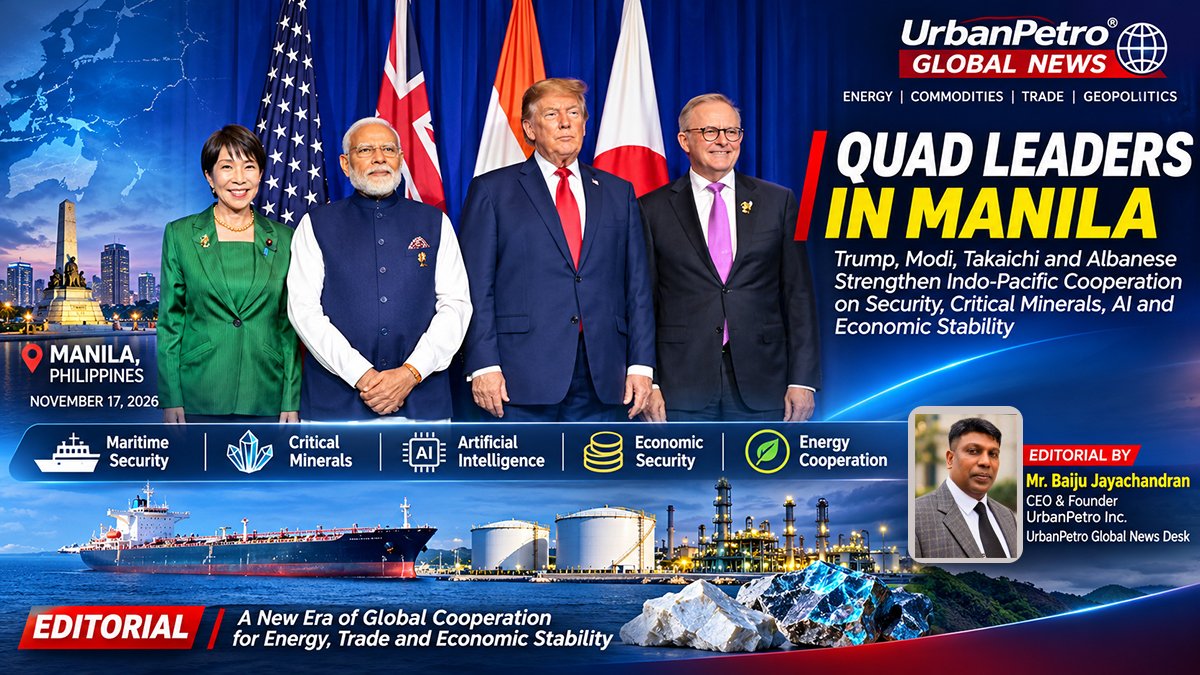
Historic Quad Summit | Manila, Philippines | November 17, 2026
Published by: UrbanPetro Global News Desk
Editorial Contributor: Mr. Baiju Jayachandran
CEO & Founder | UrbanPetro Inc.
1. FOUR GLOBAL LEADERS, ONE STRATEGIC VISION
MANILA, PHILIPPINES — November 17, 2026.
The Philippine capital, Manila, has become the center of international diplomatic attention as the leaders of four influential Indo-Pacific democracies gathered for a historic Quadrilateral Security Dialogue (QUAD) summit.
The meeting brought together:
- Donald Trump – President of the United States.
- Narendra Modi – Prime Minister of India.
- Sanae Takaichi – Prime Minister of Japan.
- Anthony Albanese – Prime Minister of Australia.
The four leaders met on the sidelines of the 49th Association of Southeast Asian Nations (ASEAN) Summit, marking the first Quad leaders’ summit in more than two years and the first such gathering since President Donald Trump returned to the White House.
The Manila meeting represents an important moment for international diplomacy, regional security, economic cooperation and the future balance of power across the Indo-Pacific.
At a time when global trade routes, energy security, technological competition and geopolitical relationships are undergoing significant changes, the four countries are seeking stronger coordination to address emerging international challenges.
The gathering is not simply a diplomatic photograph. It represents an effort to establish a stronger framework for cooperation between four strategically important economies.
2. WHAT IS THE QUAD AND WHY DOES IT MATTER?
The Quadrilateral Security Dialogue, commonly known as the QUAD, is a strategic diplomatic partnership involving the United States, India, Japan and Australia.
Its origins are connected to humanitarian cooperation following the devastating 2004 Indian Ocean tsunami. The four countries subsequently developed a broader diplomatic framework, with the partnership becoming increasingly significant in the Indo-Pacific region.
The Quad promotes cooperation in several important areas:
- Maritime security and regional stability.
- International trade and supply-chain resilience.
- Critical minerals and strategic resources.
- Artificial intelligence and emerging technologies.
- Infrastructure development.
- Disaster response and humanitarian assistance.
- Economic security and technological cooperation.
Although the Quad is frequently discussed in the context of China’s growing regional influence, its member countries describe the partnership as supporting a free, open, inclusive and rules-based Indo-Pacific.
The Manila summit demonstrates that the partnership continues to have strategic importance.
3. MARITIME SECURITY: PROTECTING THE WORLD’S COMMERCIAL SHIPPING ROUTES
One of the most important dimensions of the Quad partnership is maritime security.
The Indo-Pacific contains some of the world’s most commercially important shipping corridors. These routes connect major manufacturing centres, energy suppliers, commodity exporters and international consumer markets.
For the global petroleum and commodity industries, maritime stability is essential.
International shipping routes carry enormous quantities of:
- Crude oil and refined petroleum products.
- LNG and LPG.
- Diesel and gasoline.
- Industrial minerals and metals.
- Agricultural commodities.
- Manufacturing materials and essential goods.
Disruptions in maritime transportation can increase shipping costs, insurance premiums, delivery times and commodity prices.
The Quad leaders have placed maritime cooperation among their strategic priorities.
During the Manila gathering, President Trump announced plans for a joint exercise involving maritime patrol aircraft.
This initiative is significant because maritime surveillance and coordinated security operations can improve awareness of activities across important international waterways.
For countries dependent on imported energy, reliable shipping routes are not merely a commercial issue. They are a matter of national economic security.
4. CRITICAL MINERALS: THE NEXT GLOBAL ECONOMIC BATTLEFIELD
Another major issue surrounding the summit is the security of critical mineral supply chains.
Critical minerals have become essential to the modern global economy.
They are required for:
- Electric vehicle manufacturing.
- Battery production.
- Renewable energy infrastructure.
- Advanced electronics.
- Semiconductor manufacturing.
- Aerospace and defence industries.
- Artificial intelligence infrastructure.
- Industrial and energy technologies.
The United States, Australia, Japan and India have significant interests in building more reliable and diversified supply chains.
Australia possesses important mineral resources, India represents a major industrial and consumer market, Japan has advanced manufacturing capabilities, and the United States has substantial technological and financial capacity.
Their combined cooperation could influence future investment patterns in mining, processing, refining, transportation and industrial development.
For emerging resource-producing economies in Latin America, Africa and Central Asia, this development deserves particular attention.
Countries with lithium, copper, rare earth elements and other strategic resources may have opportunities to attract international investment and establish new commercial partnerships.
Bolivia, with its significant lithium resources, is particularly relevant to this wider discussion.
However, mineral resources alone do not guarantee economic success. Investment, technology, infrastructure, environmental standards and transparent commercial agreements are equally important.
5. ARTIFICIAL INTELLIGENCE AND THE TECHNOLOGICAL FUTURE
Artificial intelligence is increasingly becoming a central issue in international economic and strategic competition.
At the Manila summit, President Trump announced that the Quad would advance cooperation in what he described as superintelligence, referring to advanced artificial intelligence.
The leaders also discussed technological cooperation and initiatives intended to strengthen their collective capabilities.
AI is no longer limited to software development or technology companies.
It is transforming:
- Global banking and financial services.
- International logistics and shipping.
- Petroleum exploration and energy management.
- Commodity pricing and market intelligence.
- Industrial automation.
- Cybersecurity.
- International trade documentation.
- Supply-chain management.
The future of economic competitiveness will increasingly depend on access to advanced technology, computing infrastructure, skilled professionals and reliable energy supplies.
The Quad’s technological ambitions therefore have implications well beyond the technology sector.
6. ECONOMIC SECURITY AND INTERNATIONAL TRADE
Economic security was another central theme of the Manila gathering.
In their joint statement, the four leaders opposed destabilising or unilateral actions seeking to change the status quo through force or coercion.
They also expressed serious concerns about economic coercion, including arbitrary export restrictions.
This is an important message for international businesses.
Modern economies depend on interconnected supply chains. Restrictions affecting strategic commodities, industrial materials or essential technologies can create economic pressure far beyond the countries directly involved.
For international commodity traders, refiners, manufacturers and logistics companies, supply-chain diversification has become increasingly important.
Businesses must consider alternative suppliers, multiple shipping routes, financial stability, regulatory compliance and long-term commercial partnerships.
The Quad’s position highlights the growing connection between national security and international economic policy.
7. THE ENERGY DIMENSION: WHY THE QUAD MATTERS TO GLOBAL PETROLEUM MARKETS
Energy security is one of the most important considerations in the changing international geopolitical environment.
The global economy depends on stable supplies of crude oil, refined petroleum products, natural gas and other essential energy resources.
Any disruption to major shipping corridors or energy-producing regions can affect international markets.
The Indo-Pacific is particularly important because it connects major energy-producing and energy-consuming economies.
Japan and India are major energy importers. Australia is an important energy exporter. The United States is a major producer and exporter of energy resources.
These different positions create opportunities for cooperation in energy trade, infrastructure, logistics and supply-chain security.
For the petroleum industry, several developments deserve close monitoring:
A. Security of shipping routes
Commercial vessels transporting petroleum products must have access to safe and predictable international waterways.
B. Diversification of energy suppliers
Importing countries increasingly seek multiple sources of supply to reduce exposure to geopolitical disruptions.
C. Strategic energy infrastructure
Storage terminals, refineries, pipelines, ports and transportation networks are becoming increasingly important components of national energy security.
D. Critical minerals and the energy transition
Lithium, copper and other strategic materials are essential to electricity networks, battery technologies and renewable energy infrastructure.
E. International investment
Governments and private investors may increasingly direct capital towards secure energy infrastructure and diversified supply chains.
These developments demonstrate that energy security is not simply about production. It also depends on transportation, storage, financing, infrastructure and international cooperation.
8. LATIN AMERICA: NEW OPPORTUNITIES IN A CHANGING GLOBAL ORDER
While the Quad is an Indo-Pacific partnership, its decisions and strategic priorities have international consequences.
Latin America has an important role to play in the future global economy.
The region possesses substantial natural resources, agricultural capacity, mineral deposits, energy potential and strategic transportation opportunities.
Bolivia, Brazil, Chile, Argentina and other regional economies have different advantages in the international commodities market.
Bolivia’s lithium potential, Brazil’s industrial and agricultural capabilities, and Chile’s copper and mining industries could become increasingly relevant as global demand for strategic resources develops.
The challenge for Latin American countries is to transform natural resources into sustainable economic development.
This requires:
- International investment.
- Modern transportation infrastructure.
- Transparent mining agreements.
- Reliable energy supply.
- Advanced processing facilities.
- Strong financial institutions.
- International commercial partnerships.
- Long-term industrial development policies.
The changing relationship between major global powers could create opportunities for Latin American economies to expand their international commercial relationships.
Countries should avoid excessive dependence on a single market or strategic partner.
A diversified international economic strategy can provide greater resilience.
9. CHINA AND THE FUTURE OF THE INDO-PACIFIC
No serious discussion of the Quad can ignore China’s growing economic, industrial and geopolitical influence.
China is a major global manufacturing centre, an important trading partner for numerous economies and a significant participant in international infrastructure and technology development.
The Quad’s strategic importance is partly connected to concerns about maintaining regional stability and preventing unilateral changes to the existing international order.
However, the future of the Indo-Pacific should not be viewed exclusively through the lens of confrontation between major powers.
Regional stability requires diplomatic engagement, predictable international trade, respect for sovereignty and peaceful resolution of disputes.
The economic relationship between the Quad countries and China is complex. Competition exists alongside extensive commercial interdependence.
The challenge for international leaders is to manage strategic differences without creating unnecessary disruptions to global trade and economic development.
10. A HISTORIC DIPLOMATIC MOMENT FOR MANILA
The Philippines has provided an important diplomatic setting for this gathering.
As ASEAN chair in 2026, the Philippines has brought regional and international leaders together to discuss security, economic cooperation and the future of Asia-Pacific relations.
The Quad summit on November 17 adds another dimension to Manila’s diplomatic significance.
Although the Philippines is not a member of the Quad, its geographic position and role in Southeast Asian diplomacy make it an important participant in wider regional discussions.
The gathering also highlights the importance of cooperation between Indo-Pacific powers and Southeast Asian countries.
The region’s future will depend not only on major powers but also on the participation of smaller and emerging economies.
URBANPETRO GLOBAL EDITORIAL
THE WORLD IS ENTERING A NEW ERA OF ECONOMIC AND STRATEGIC COMPETITION
By Mr. Baiju Jayachandran
CEO & Founder – UrbanPetro Inc.
UrbanPetro Global News Desk
The Quad leaders’ meeting in Manila is an important international development that deserves attention from governments, investors, business leaders and the global energy industry.
In my view, the significance of this meeting extends far beyond traditional diplomatic relations.
We are witnessing a major transformation in the global economic system.
International trade is increasingly influenced by geopolitical relationships, national security policies, strategic resources, technological competition and energy independence.
The world can no longer consider energy, minerals, transportation and international finance as completely separate sectors. They are interconnected elements of national economic security.
ENERGY SECURITY MUST BECOME A GLOBAL PRIORITY
One of the most important lessons from the current international environment is that energy security must remain a priority for every developing and developed economy.
Petroleum products, natural gas and other essential energy resources continue to support international transportation, manufacturing, agriculture and industrial development.
A country may possess enormous natural resources, but without reliable infrastructure, investment, transportation and international commercial relationships, those resources cannot achieve their full economic potential.
The international community must therefore focus on practical cooperation rather than political declarations alone.
LATIN AMERICA MUST THINK STRATEGICALLY
Latin America has the natural resources and economic potential to become an increasingly important participant in international energy and commodity markets.
Bolivia, in particular, must develop a long-term strategy that connects its natural resources with international investment, industrial development and reliable export infrastructure.
Lithium, copper, petroleum, natural gas and agricultural resources can support economic growth when managed through transparent and commercially sustainable frameworks.
However, governments must establish the conditions necessary to attract serious international investors.
This includes legal certainty, transparent procedures, efficient customs systems, modern logistics and reliable financial infrastructure.
INTERNATIONAL BUSINESS MUST ADAPT
From the perspective of international commodity trading, the future will belong to companies capable of managing complex global supply chains.
The petroleum industry must adapt to changing geopolitical conditions, new transportation requirements, financial regulations and emerging energy technologies.
International companies must build stronger relationships with producers, refiners, storage operators, shipping companies, financial institutions and government authorities.
The ability to maintain reliable supply arrangements and transparent commercial operations will become increasingly important.
COOPERATION IS BETTER THAN ECONOMIC CONFRONTATION
Major international powers have legitimate national interests. However, economic confrontation can create consequences for millions of businesses and consumers around the world.
International trade should not become an instrument that unnecessarily destabilises developing economies.
Countries should compete through technology, investment, industrial capacity and innovation while maintaining diplomatic channels and respecting international law.
A stable international economic environment benefits producers, consumers, investors and governments.
MY MESSAGE TO GLOBAL LEADERS
The Quad leaders’ gathering in Manila should be viewed as an opportunity to strengthen international cooperation.
The world needs more secure shipping routes, reliable energy supplies, diversified critical mineral markets, responsible investment and transparent international trade.
The future should not be determined exclusively by the competition between major powers.
Emerging economies must also have opportunities to participate in global development, access international markets and attract investment without being forced into unnecessary geopolitical divisions.
Our position is clear: energy security, economic stability and international cooperation must remain central priorities for the next generation of global leadership.
The strength of international diplomacy should ultimately be measured not by the number of meetings held, but by the practical improvements it delivers to global peace, economic development and the lives of ordinary people.
Mr. Baiju Jayachandran
CEO & Founder
URBANPETRO INC.
UrbanPetro Global News Desk
CONCLUSION: THE NEXT CHAPTER OF GLOBAL COOPERATION
The November 17 Quad summit in Manila marks an important moment in the continuing evolution of Indo-Pacific diplomacy.
The four leaders have placed maritime security, critical minerals, artificial intelligence and economic security at the centre of their cooperation.
For the international community, the message is significant: the future global economy will increasingly depend on secure supply chains, reliable energy infrastructure, advanced technology and strategic international partnerships.
For Latin America and other emerging economies, this changing environment presents both opportunities and challenges.
The world is entering a new chapter in which economic strength, resource security, technological development and diplomatic cooperation will shape international influence.
UrbanPetro Global News will continue monitoring developments in international energy markets, global commodity trading, geopolitical relations and strategic economic partnerships.
URBANPETRO GLOBAL NEWS DESK
Global Energy. International Trade. Strategic Intelligence.